Plastic Bag Critter Crochet+Construction

Jul 20 Sat
2:00pm - 6:00pm @ The IFF

Workshop


Plastic bag crochet.

Plastic bag crochet.

Join the IFF’s visiting Science and Art ResidentChristine Wertheim – for a workshop of plastic-bag crochet and an afternoon making fantastical organisms out of discarded plastic geep-gaws. Bring your own plastic bags if you have a stash at home – especially dry cleaning bags – and recycle them into an evolutionary art-work. Crochet hooks will be provided – along with plenty of plastic bags in a variety of splendid colors. The workshop is held in conjunction with Christine’s on-site Residency at the IFF, during which she is creating a landscape of large-scale organic sculptures inspired by the Silurian Age that reflect on the evolution of life on earth and emergence of form in the natural world.

We invite you to bring in your favorite plastic rubbish – particularly discarded airline earphones and headsets.
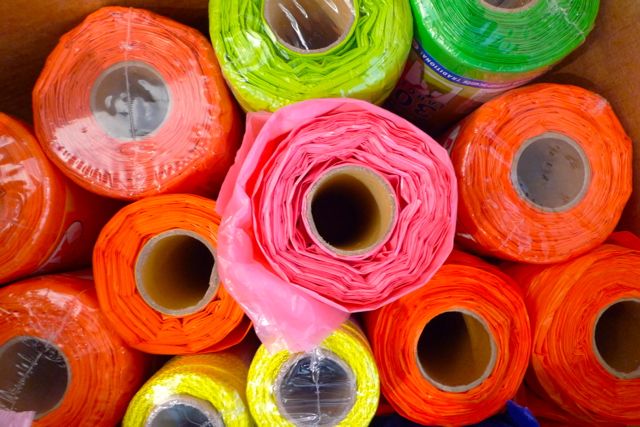
CW-plastic bags

Rolls of brightly colored plastic bags to be turned into “plarn”.

The IFF’s 2013  Science and Art Residency extends the Institute’s interest in hands-on practices inspired by scientific themes by hosting thinker-makers who work at the boundary of the theoretical and material. During summer and fall, our two residents – Christine Wertheim and Jake Dotson – will take over the Institute to use it as a studio laboratory and space for public engagement. This year’s theme Being Formed, focuses around the question of how form arises in the natural world, a subject that has inspired philosophers and scientists from Aristotle and Kant to Darwin and Einstein.

Science + Art Residency – Christine Wertheim

Detail of plastic crochet silurian creature by Christine Wertheim.

Detail of “Plastic Silurian” sculpture by Christine Wertheim.

On July 12, the Institute For Figuring welcomes its first Science and Art ResidentChristine Wertheim – who begins work on her Ladies Silurian installation, a series of large-scale sculptural forms crocheted out of shopping bags, earphones, cable ties and other plastic detritus. During the Residency, Christine will be on-site in the gallery and will host a series of workshops to create organically inflected forms inspired by the Silurian Age, a period in Earth’s history when the first jawed fish appeared and living things made the transition from sea to land.

________________________________

Closing Reception for Making Space on July 6

1017638_641623459200246_838229107_n

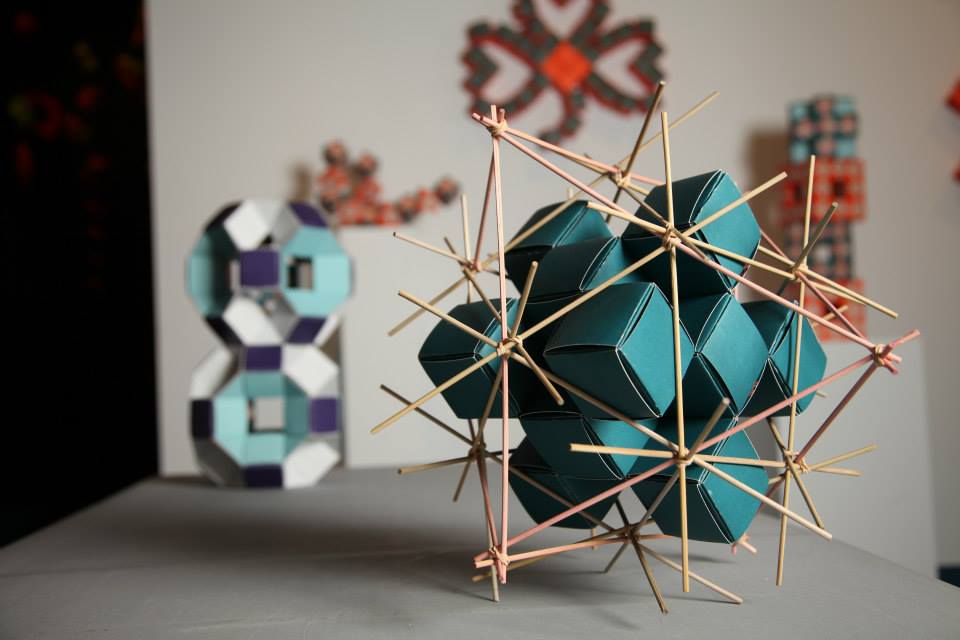
Business card origami and stick thing model by David Orozco. Photo by Christina Simons.

Please join us on July 6 for the closing celebration of making space as the Institute for Figuring revisits its six-month-long exercise in applied mathematics and participatory aesthetic practice. Witness our growing taxonomy, share in business card origami techniques and enjoy the premier of our collaborative stop-motion animation film The Inner Life of a Cube.

Beginning in December 2012, the Institute for Figuring has invited visitors to contribute to an ongoing ecology of spatial forms and geometric sculptures. Through a series of lectures, workshops and conversations with mathematicians, scientists and artists, we have woven our way through a playful and pedagogically rich exploration in hands-on mathematics. Our ‘play tank’ has experimented with beads, paper strips, bamboo sticks, weaving, folding, taping and – most notably – over 60,000 specially designed business cards. Beginning with modular origami and fractal building techniques developed by engineer Jeannine Mosely, the IFF and its audience has since taken up business card origami, pleated paraboloids, hyperbolic annuli, polyhedral beading, and bamboo platonic solids all while asking the question, what else might be possible?

Please Join Us:
Saturday, July 6
5:00 – 8:00pm
@ the IFF

__________________________________

Closing Celebration for Making Space

Jul 06 Sat
5:00-8:00pm @ the IFF

Reception


1017638_641623459200246_838229107_n

Business card origami and stick thing model by David Orozco. Photo by Christina Simons.

Please join us for the closing celebration of making space as the Institute for Figuring revisits its six-month-long exercise in applied mathematics and participatory aesthetic practice. Witness our growing taxonomy, share in business card origami techniques and enjoy the premier of our collaborative stop-motion animation film The Inner Life of a Cube.

Beginning in December 2012, the Institute for Figuring has invited visitors to contribute to an ongoing ecology of spatial forms and geometric sculptures. Through a series of lectures, workshops and conversations with mathematicians, scientists and artists, we have woven our way through a playful and pedagogically rich exploration in hands-on mathematics. Our ‘play tank’ has experimented with beads, paper strips, bamboo sticks, weaving, folding, taping and – most notably – over 60,000 specially designed business cards. Beginning with modular origami and fractal building techniques developed by engineer Jeannine Mosely, the IFF and its audience has since taken up business card origami, pleated paraboloids, hyperbolic annuli, polyhedral beading, and bamboo platonic solids all while asking the question, what else might be possible?

Please Join Us:
Saturday, July 6
5:00 – 8:00pm
@ the IFF

Alternative Guide to the Universe @ Hayward Gallery

An Alternative Guide to the Universe at the Hayward Gallery, London. June 2013.

An Alternative Guide to the Universe at the Hayward Gallery, London. June 2013.

Opening this week is a mind-expanding exhibition at the Hayward Gallery in London. Titled An Alternative Guide to the Universe this venue-filling extravaganza features work by visionary outsiders in art, science, engineering, photography and architecture. IFF director Margaret Wertheim has curated the section on outsider physics, showcasing diagrams and animations by James Carter – hero of her book Physics on the Fringe – and elaborate models of subatomic particles by newly discovered, Pasadena-based, “quantum geometry” theorist Philip Blackmarr. Carter and Blackmarr appear in the Beautiful Theories part of the exhibition. Accompanying the show is a catalog to which Margaret has contributed an essay.

The Telegraph – Press Review
The Guardian – Press Review

________________________________________

“Physics Pangolin” @ Aeon Magazine

Illustration by Claire Scully. Courtesy Aeon Magazine.

Illustration by Claire Scully. Courtesy Aeon magazine.

IFF Director Margaret Wertheim has written an article about the philosophy of physics for the London-based online magazine AEON. Titled “Physics Pangolin” the piece explores how physicists describe the world through mathematics and asks the philosophical question of whether there are limits to this way of knowing.

__________

Dr. Jeannine Mosely @ IFF June 14 and 15

Jun 14 Fri
12:00 noon - 6:30pm @ the IFF

In Residence


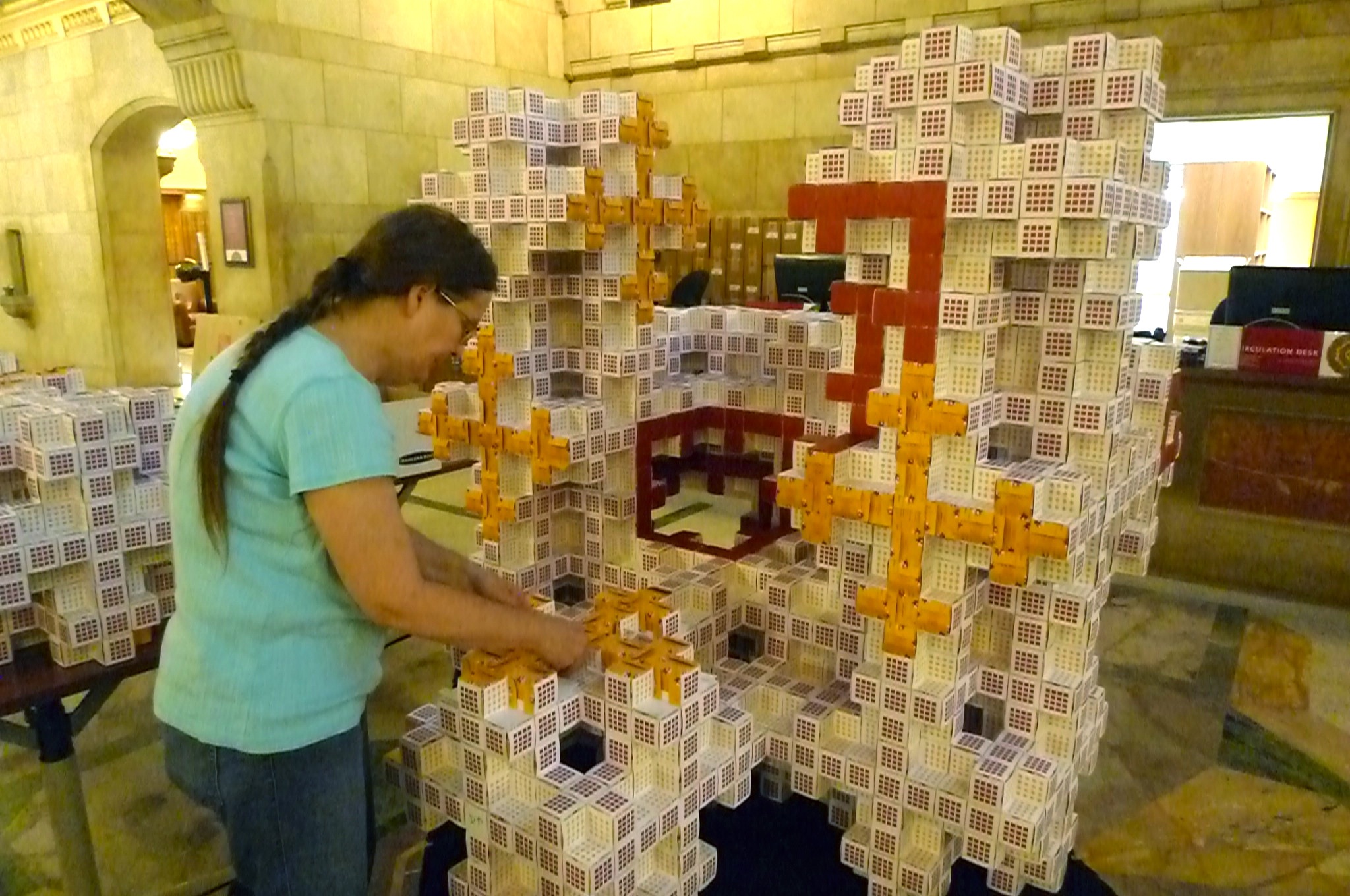
Dr. Jeannine Mosely constructing the Mosely Snowflake Fractal at the University of Southern California Libraries, August 2012.

Dr. Jeannine Mosely constructing the Mosely Snowflake Fractal at the University of Southern California Libraries, August 2012.

On Friday June 14 and Saturday June 15, Dr Jeannine Mosely will be in residence at the IFF.

Mosely’s pioneering work on business card origami was a major inspiration for the IFF’s current exhibition Making Space. Those interested in discussing this unique, mathematically inflected art form are invited to drop by for impromptu discussions with and demonstrations by Dr. Mosely.

Dr. Jeannine Mosely is a software engineer who specializes in geometric visualizations. Since the early 1990’s she has been a pioneering practitioner in the field of technical folding or origami sekkei and has been the leading force in the development of business card origami. From 1997-2005, Mosely spearheaded a national US effort to construct a Level Three model of the famous three-dimensional fractal known as the Menger Sponge out of 66,000 business cards. In 2005 she worked with the Wooster School District in Massachusettes to design and build a model of the Wooster Union Train Station from 60,000 cards, and in 2012 she led an effort at the University of Southern California Libraries (along with IFF Director Margaret Wertheim) to construct a Level Three  model of the Mosely Snowflake Fractal.  Dr. Mosely is also a pioneer in the science of curved paper folding.

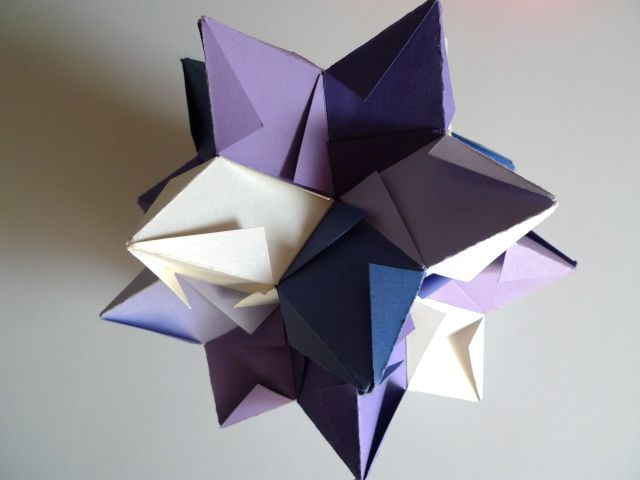
"Stellated tricontahedron" made from diagonally folded business cards assembled into prismatic units, by Dr Jeannine Mosely.

“Stellated tricontahedron” made from diagonally folded business cards assembled into prismatic units, by Dr Jeannine Mosely.

Dr. Jeannine Mosely: Business Card Origami Science

Jun 15 Sat
7:00pm @ the IFF

Lecture


Dr. Jeannine Mosely constructing the Business Card Menger Sponge.

Dr. Jeannine Mosely constructing the Business Card Menger Sponge.

For the past 50 years, modular paper folding has been an increasingly important branch of origami, drawing on techniques often more associated with architecture and structural design. Where traditional origami works are folded from a single sheet, modulars are constructed from hundreds or thousands of folded units fitted together in complex geometric configurations. Dr. Jeannine Mosely, an MIT trained software engineer, has been one of the leading practitioners of this challenging artform. In 1995, Mosely began to explore what could be constructed from the humble module of the business card. Folded into cubes, she discovered that business cards could be linked together into arbitrarily complex shapes, including fractals. Since then she has led major projects to build several giant fractal models, including the famous Business Card Menger Sponge  (66,000 cards, 2005) and the Mosely Snowflake Sponge (49,000 cards, 2012). In addition, she has developed techniques for folding business cards into other prismatically-shaped modules. Dr. Mosely’s work has been a major inspiration for the IFF’s current exhibition Making Space and has ignited the imaginations of folders all over the world.

In this event she will talk about the history of business card origami and discuss the mathematical and engineering challenges of designing and building these large-scale, hand-made forms.

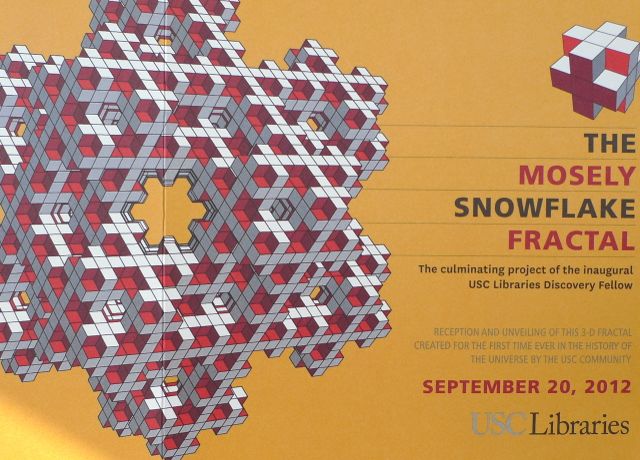
The Mosely Snowflake Fractal project at the USC Libraries, 2012.

The Mosely Snowflake Fractal project at the USC Libraries, 2012.


IFF at the Denver Art Museum

-1Over summer, the Denver Art Museum is devoting itself to a museum-wide celebration of fiber arts, entitled SPUN: Adventures in Textiles. The show is the largest suite of exhibitions DAM has ever mounted, engaging the energies of 14 curators. The IFF’s Crochet Coral Reef Traveling Exhibition is staged throughout the museum, providing pockets of intense color within the vast Daniel Libeskind-designed complex. In addition, DAM is hosting the Denver Satellite Reef, a highlight of SPUN‘s public engagement. This newest Satellite of the Crochet Coral Reef project will grow throughout the summer, with participants adding crochet coral to the display in real time. SPUN and its public engagement programming runs from May 19 – September 22, 2013.

__________

Origami innovation

B

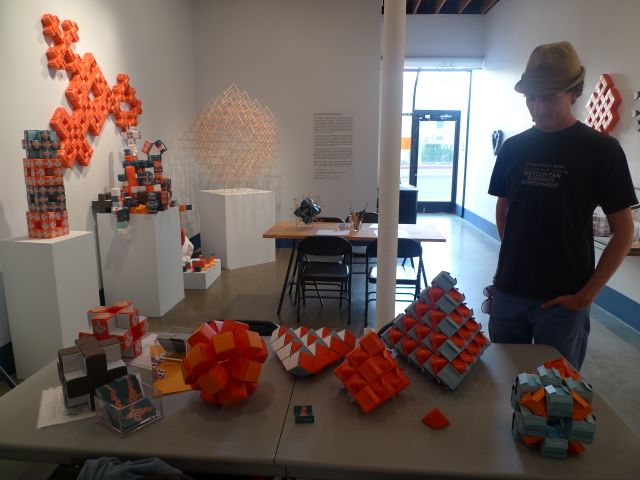
Business card origami structures folded on the bias by Jake Dotson.

Recently, one of our star business card folders, Jacob Dotson, stopped by with a number of new structures he’s been working on. He’s discovered that by folding cards on the bias he can make pyramidal units that link together like Jeannine Mosely’s traditional business card cubes. This folding innovation allows for a new range of architectures, particularly ziggurat-like forms. The bias-folded cards open a window for exploration: “This is just the beginning” Dotson says. “I’ve got lots of ideas for where this can go.”