Deutsches Museum

CD_L_6886_11-1

The IFF has news from the Deutsches Museum in Munich, the world’s largest science and technology museum, famed for its enormous collection of machines. One of our crochet Satellite Reefs was featured in their ground-breaking show Welcome to the Anthropocene, hailed as “the first major exhibition” on this subject. A post-exhibit survey has revealed that the Reef was “the second-most liked” object in the show, and in a welcome break from tradition drew a wide female audience into a venerable institution whose audience is overwhelmingly male. The Reef – picture above – is an outcropping of the Fohr Satellite Reef specially constructed for the Deutsches Museum show.


The Poetic Enchantments of Science

Apr 21 Fri
2pm-4pm @ Deakin University

Seminar: Science + Art


IFF director Margaret Wertheim will be speaking about the poetic enchantments of science, and the IFF’s practice as a “play tank” operating at the nexus of art, science, mathematics and fantastical pedagogy. The event is part of Deakin University’s REDI Seminar Series and will be held at the Deakin Downtown campus, 727 Collins Street, Melbourne (Level 12, Tower 2). The seminar is free and open to the public. Please register online by April 17.


Screen Shot 2017-04-09 at 5.04.05 AM

Screen Shot 2017-04-09 at 5.04.43 AM

Ms. Wertheim is currently a Phd Candidate in Deakin University’s Faculty of Arts and Education.

Event pdf

Register for the seminar online

Outsider Science in the Washington Post

In the Washington Post, IFF director Margaret Wertheim has an essay on outsider physics, inspired by Ren Weschler’s enchanting new book Waves Passing in the Night about Walter Murch, the legendary Hollywood film-and-sound editor who has his own cosmological theory. Here she draws parallels with outsider art.

Detail of the Periodic Table, as described by James Carter's theory of "Circlon Synchronicity."

Wertheim coined the term “outsider science” in her 2011 book Physics on the Fringe, a sociological study of the mavericks who invent alternative theories of the universe in their backyards and basements. In 2012, she curated an exhibition about this work at the IFF’s former exhibition-space in Los Angeles, celebrating the theories of her book’s hero James Carter, the Hieronymus Bosch of the field. At the IFF we salute Jim and his magical vision of the world.

Detail of the Periodic Table, as described by James Carter's theory of "Circlon Synchronicity."

Details of the Periodic Table, as described by James Carter’s theory of “Circlon Synchronicity.”


Adelaide Festival – Rekindling Venus

Mar 09 Thu
6pm - 7pm @ The Palais, Adelaide

Public Event


131-500x463

Still from “Coral: Rekindling Venus,” by Lynette Wallworth.

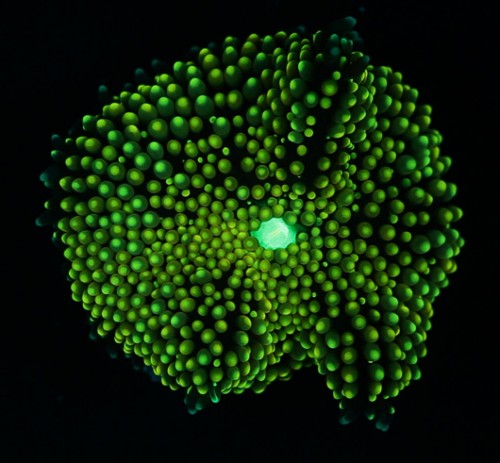
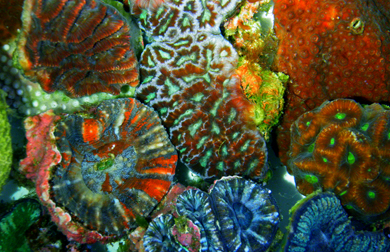
At the Adelaide Festival, writer, commentator and TV compare Annabel Crabb will host a discussion about corals in art and science, in conjunction with a screening of the extraordinary planetarium film Coral: Rekindling Venus, by new-media pioneer Lynnette Wallworth. Joining Crabb and Wallworth is IFF director Margaret Wertheim, co-creator of the Crochet Coral Reef project, and scientist Anya Salih whose heads a laboratory that is researching how corals fluoresce. 4 remarkable women will reflect on the remarkable organisms of coral – their aesthetic power, their ecological criticality, and what they are teaching us about quantum mechanical interactions with light.

Discussion Moderator:
Annabel Crabb is an Australian journalist and commentator who is the ABC’s chief online political writer. She has worked for The Sydney Morning HeraldThe Age, the Sunday Age and The Sun-Herald, and won a Walkley Award in 2009 for her Quarterly Essay, “Stop at Nothing.”

corals1_light_LHowe2010_web

Coral fluorescing. Image courtesy Dr. Anya Salih, University of Western Sydney.

Discussion Participants:
Lynette Wallworth is an Australian artist who uses interactive technologies to create immersive installations. Wallworth’s artworks have been exhibited widely including at the Lincoln Center NYC and the Sundance Film Festival. Her recent work includes Coral: Rekindling Venus designed to be seen in digital planetariums, and Collisions, a ground-breaking VR film that tells the story of an Aboriginal man’s encounter with atomic bombs tests in central Australia in the 1950’s. See here

Dr Anya Salih, a scientist in the School of Science and Health at the University of Western Sydney, is researching the biological function of coral colours – the glow-in-the-dark fluorescent proteins that light up coral reefs, and are featured in the film, Coral: Rekindling Venus. Dr Salih has teamed with many scientists from around the world – marine biologists, biophysicists, molecular biologists, electrophysiologists and biochemists – to solve the mystery of coral fluorescence. See more about her lab.

Margaret Wertheim, founder and director of the Institute For Figuring, is the co-creator with her sister Christine Wertheim of the Crochet Coral Reef project, perhaps the largest science and art project in the world. To date almost 10,000 women in a dozen countries have participated in constructing an ever-evolving wooly archipelago, which has been exhibited at the Hayward Gallery in London, the Smithsonian in Washington D.C., and elsewhere. The project is currently exhibiting at the University of California, Santa Cruz. See here.

Thanks to Kate Hillgrove.

P1150387

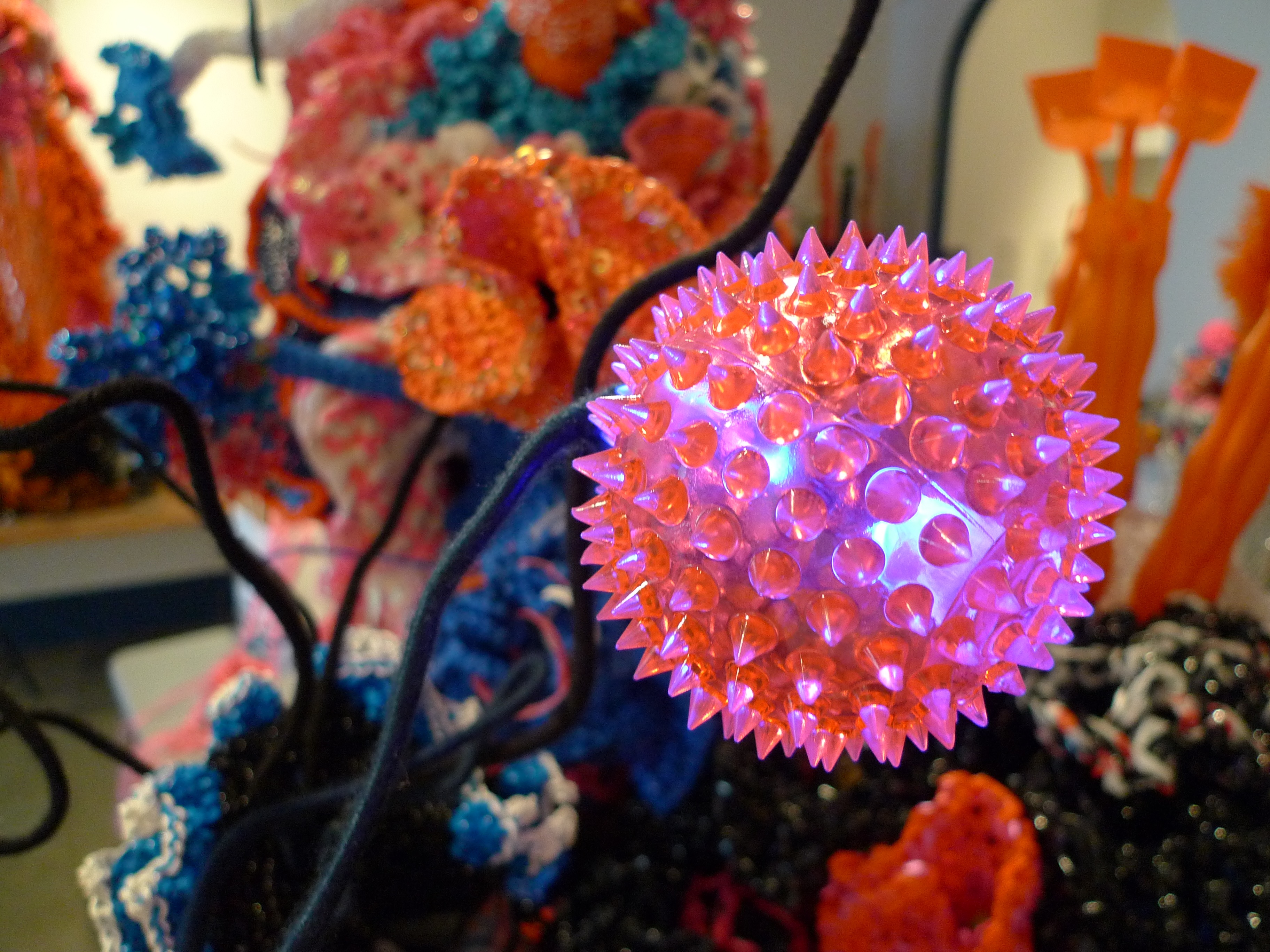
Phosphorescent plastic-ball coral head. Detail of the sculpture “Coral Forest: Ea” crocheted out of yarn, video-tape, and plastic refuse, by Margaret and Christine Wertheim – on exhibition at the Institute For Figuring (Los Angeles, 2013).

Great Barrier Reef has lost half its cover

“Climate change is not a future threat. On the Great Barrier Reef, it’s been happening for 18 years.” – Terry Hughes, coral biologist, James Cook University.

16REEF1-superJumbo

This devastating New York Timearticle chronicles the latest bleaching on the Great Barrier Reef, with 2016 the worst ever recorded and 2017 looking to be yet another epic scorcher.

“We didn’t expect to see this level of destruction to the Great Barrier Reef for another 30 years,” said Terry P. Hughes, director of a government-funded center for coral reef studies at James Cook University in Australia and the lead author of a paper  published today as the cover article of the journal Nature. “In the north, I saw hundreds of reefs — literally two-thirds of the reefs were dying and are now dead.”

The IFF’s Crochet Coral Reefs, some of which are currently on display at the UC Santa Cruz Sesnon Gallery, are an elegiac artistic response to this crisis. When Margaret and Christine Wertheim started the project they joked that if the GBR ever died out, their crochet reef would be something to remember it by. A decade later the unthinkable has become a pending possibility.

Citizens of Santa Cruz are currently crocheting a reef as the latest addition to the IFF’s worldwide wooly archipelago. For information see the UCSC Institute of the Arts and Sciences. UCSC-IAS


Aeon Article

NationalGeographic_1160360

Cold and calculating. A Dorid nudibranch (Tritoniella belli) in Antarctica. Photo by Norbert Wu/Minden/National Geographic

Sea slugs, sound waves, falcons, and electrons all enact amazingly complex pieces of mathematics. In the fibers of their being and their ongoing activities they are mathematicians-by-practice. Here in Aeon magazine, IFF director Margaret Wertheim explores the idea that math may be seen as a kind of performance akin to playing music.


UC Santa Cruz Exhibition

May 06 Sat
@ UCSC: Sesnon Gallery, Institute of the Arts & Sciences

Feb 10 - May 6, 2017


CROCHET CORAL REEF: CO2CA CO2LA OCEAN
By Margaret & Christine Wertheim & the Institute For Figuring

@ UNIVERSITY OF CALIFORNIA, SANTA CRUZ
Mary Porter Sesnon Art Gallery
Sponsored by the Institute of the Arts and Sciences

Exhibition dates: February 10 – May 6, 2017
UCSC_CoralReef_2017_041**

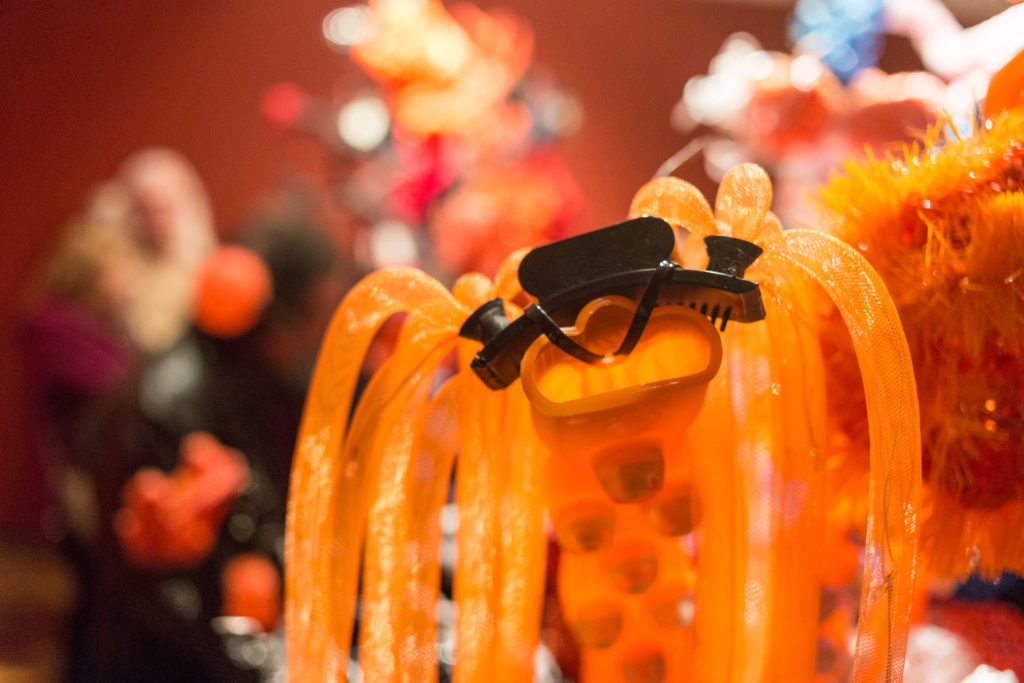
Detail of plastic trash anemone from “Coral Forest: Ea”, constructed out of found hula-hoops and cheap plastic hair ornaments.

At the IFF, we have long admired UCSC’s legendary History of Consciousness program, an important site of interdisciplinary research and practice. Donna Haraway, a Distinguished Professor Emerita of the program, is both a friend to the Reef project and an inspiration for our work; (she writes about the Reef in her newest book, Staying With the Trouble: Making Kin in the Chthulucene). When the campus’ new cross-departmental venture, the Institute of the Arts and Sciences, approached us about bringing the project to Santa Cruz, we accepted the invitation as a singular opportunity to experiment with our curatorial strategy. The resulting exhibition Crochet Coral Reef: CO2CA CO2LA Ocean, reframes the project by highlighting the cthulucene nature of the sculptures and by reimagining our plastic trash Midden as a monstrous undersea ceiling.

In conjunction with the showan accompanying year-long public art project will engage the local community in creating a UC Santa Cruz Satellite Reef that will be exhibited at the Seymour Marine Discovery Center later this year.

Crochet Coral Reef: CO2CA CO2LA Ocean and the UC Santa Cruz Satellite Reef are sponsored by the Institute of the Arts and Sciences in partnership with the Mary Porter Sesnon Art Gallery and the Seymour Marine Discovery Center. The Institute of the Arts and Sciences is part of UC Santa Cruz’s Arts Division. It is an interdisciplinary programming unit which creates public exhibitions, public events, publications, and collaborations with faculty and students, aligning with UCSC’s teaching and research. The Sesnon Gallery encourages interdisciplinary discourse through the lens of the arts.

Gallery hours: Tues–Sat, 12 p.m. to 5 p.m., Wed until 8 p.m.

*

IFF Exhibition webpage: here

UCSC/IAS Exhibition webpage: here

UCSC Satellite Reef webpage: here

*

Press:

Scientific AmericanHow to crochet a coral reef and why? here

Ideas.TED.com– Gallery: What happens when you mix math, coral and crochet? It’s mind blowing here

Santa Cruz Newsletter – IAS launches Santa Cruz Satellite Reef  here 

Santa Cruz Sentinel here,

Santa Cruz Good Times here

*

Opening Night Photos:
UCSC_CoralReef_2017_104**

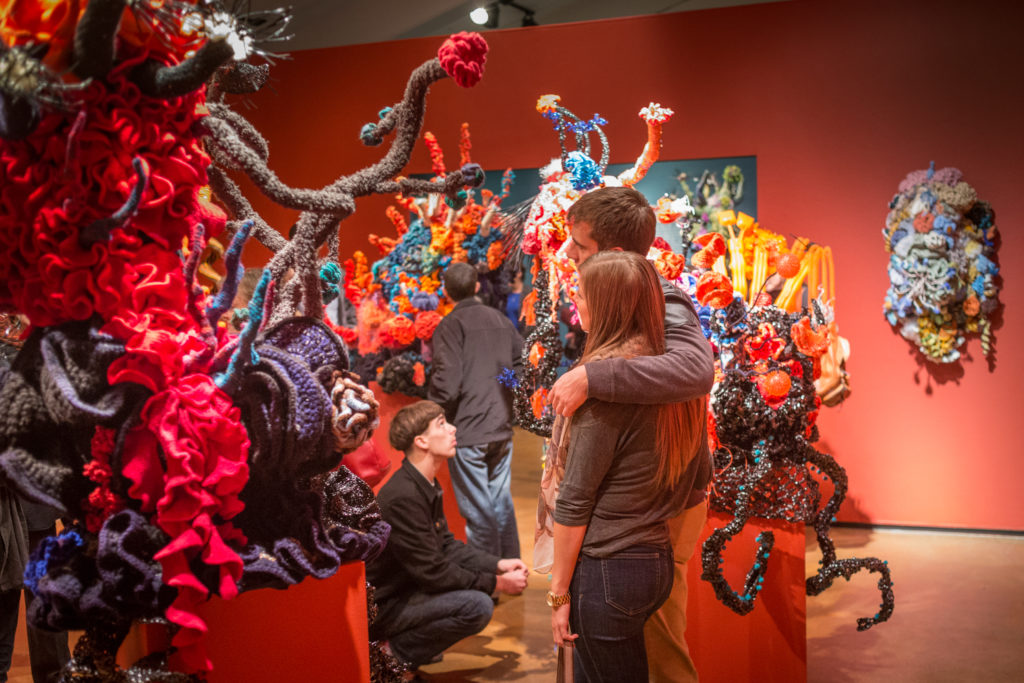
“Coral Forest” by Margaret and Christine Wertheim, constructed out of yarn and plastic trash. In background hangs a section of the “Latvian Satellite Reef” courtesy of Tija Viksna and Gallery Consiento, Riga Latvia.
UCSC_CoralReef_2017_076*

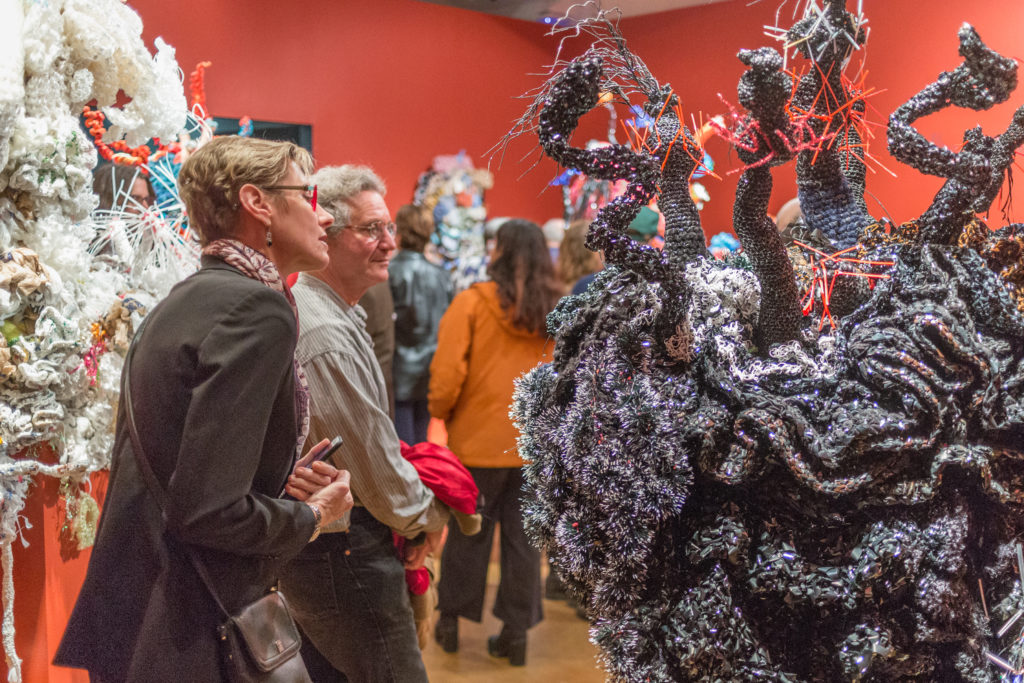
“Coral Forest: Chthulu” constructed out of video tape, tinsel, cable ties and drinking straws by Christine Wertheim, with contributions from Evelyn Hardin.
UCSC_CoralReef_2017_105**

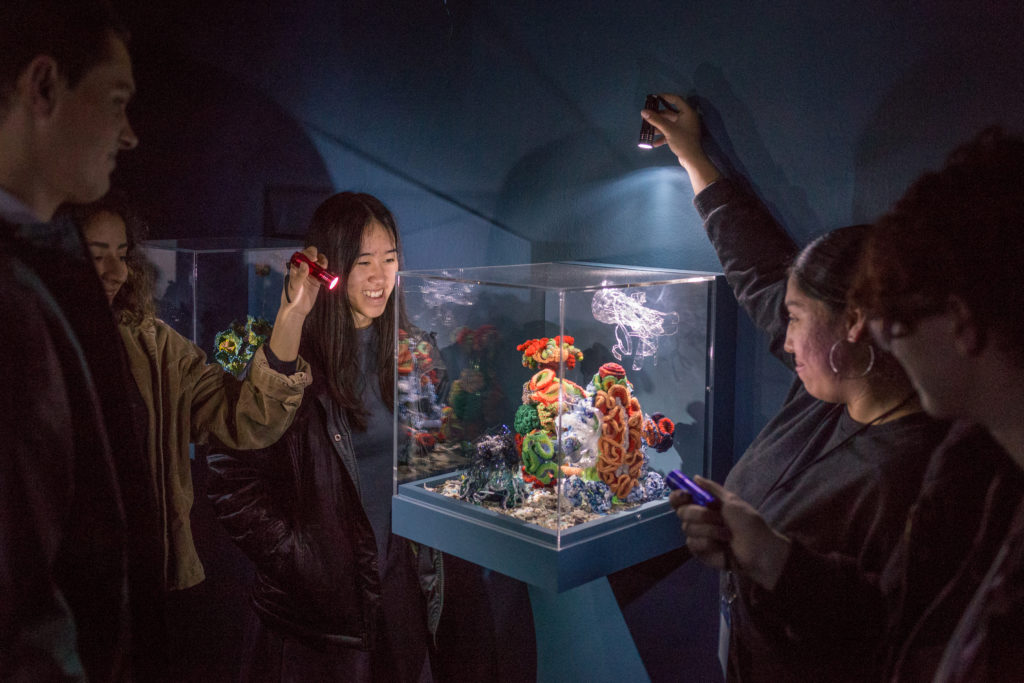
Visitors explore an “undersea grove” of miniature coral “Pod Worlds” featuring plastic bottle anemones by Nadia Severns and Vanessa Garcia. These sculptures are sitting on a bed of plastic “sand” from the Great Pacific Garbage Patch, gathered on Kamillo Beach Hawaii by Captain Charles Moore of the Algalita Foundation.
UCSC_CoralReef_2017_108*

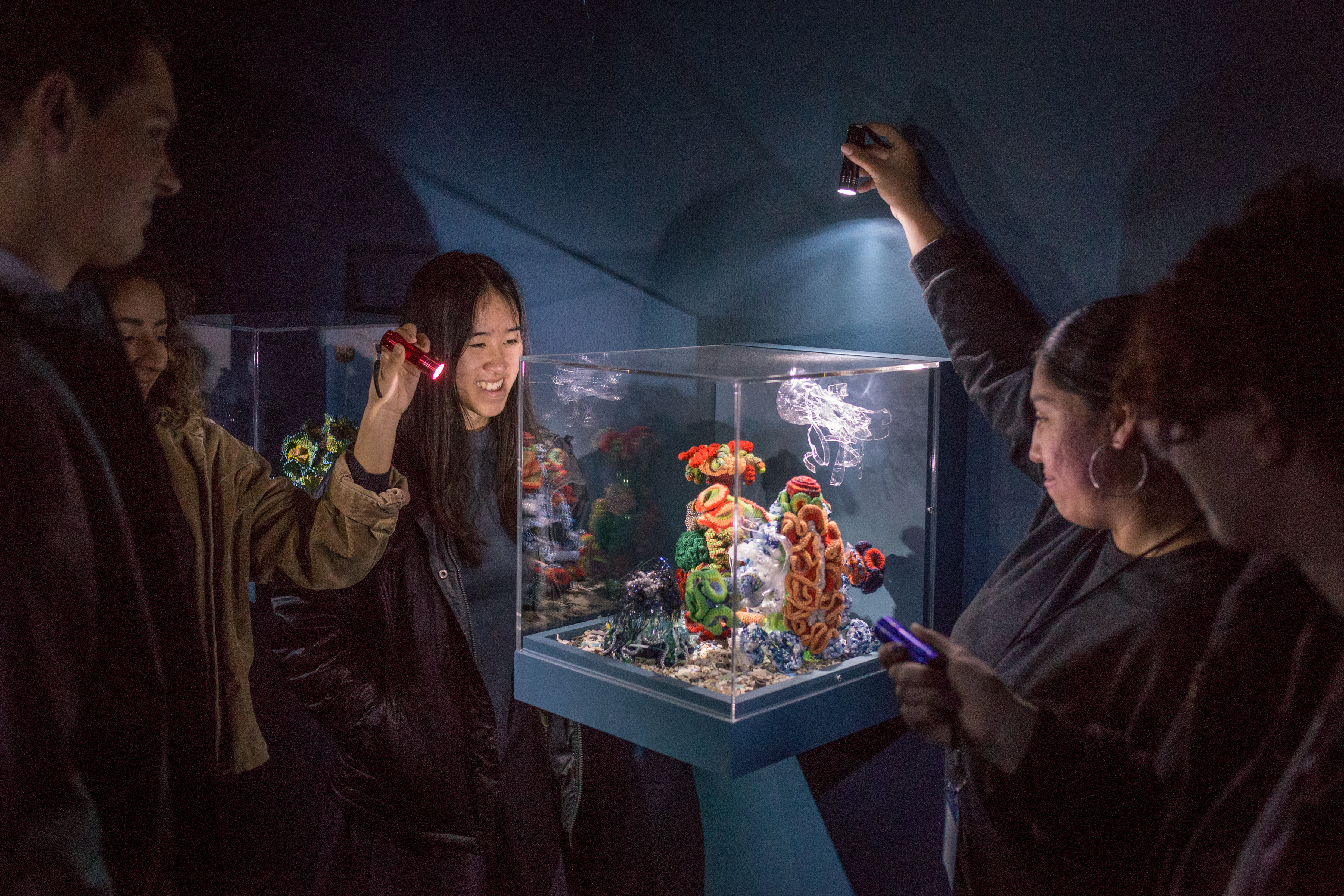
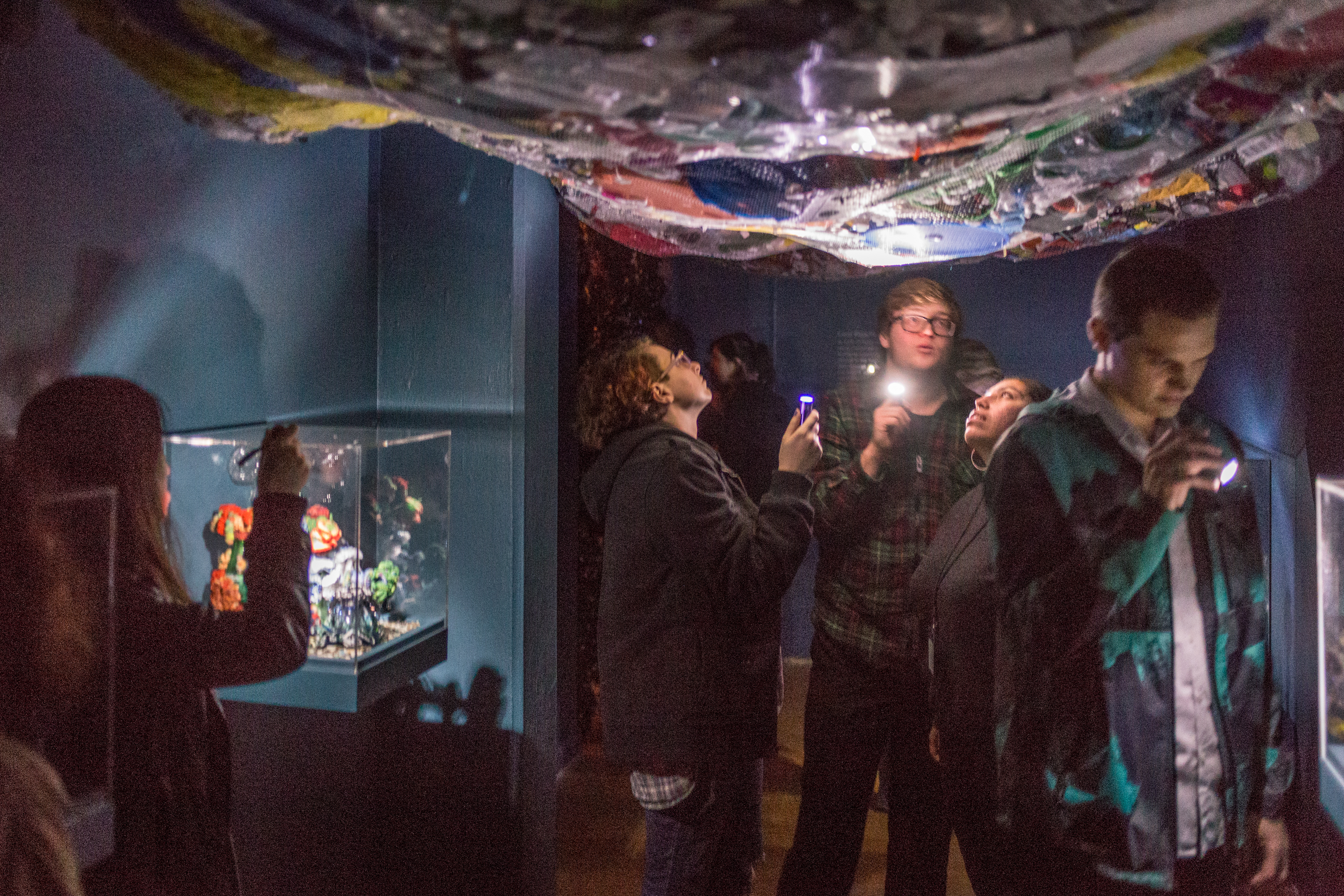
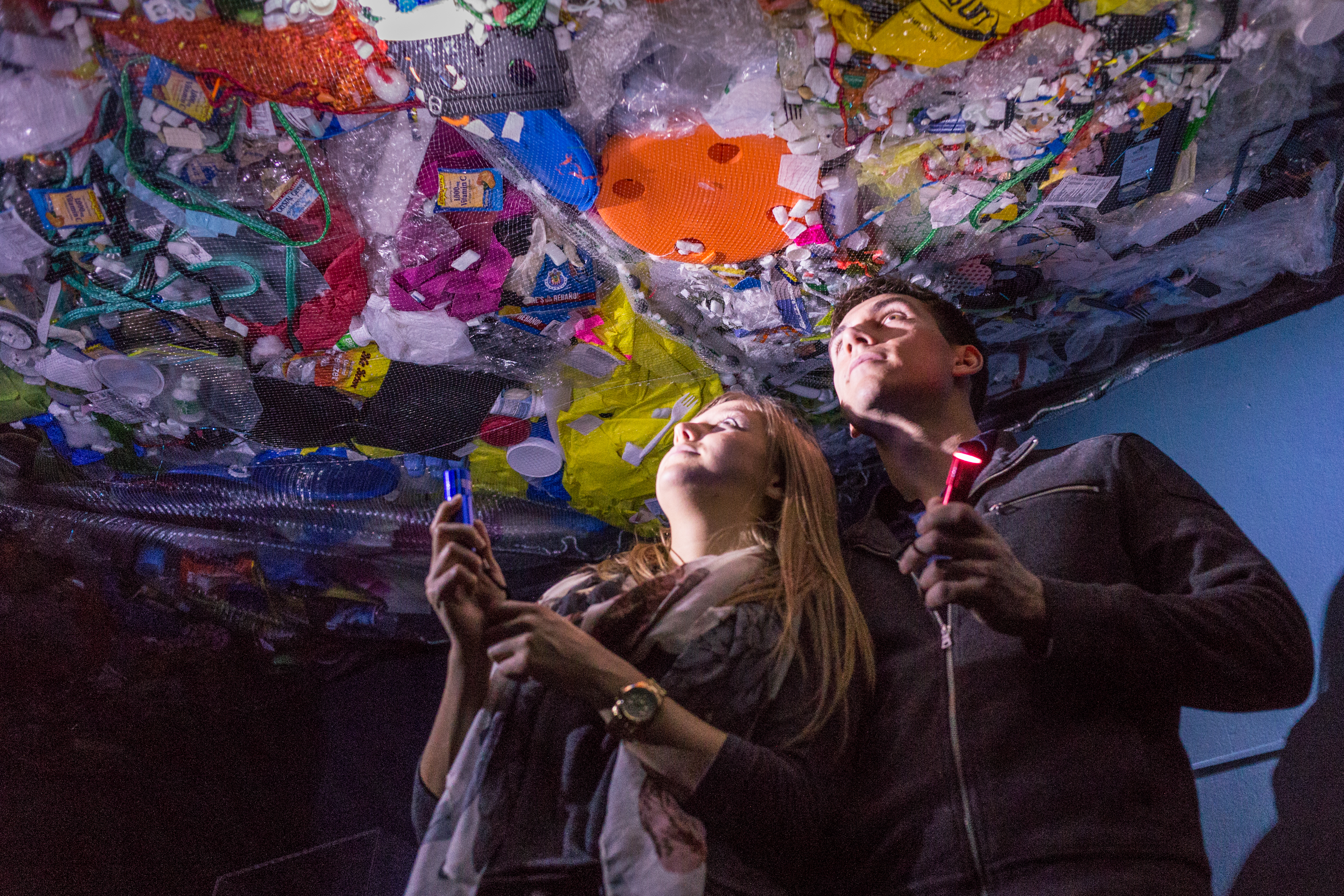
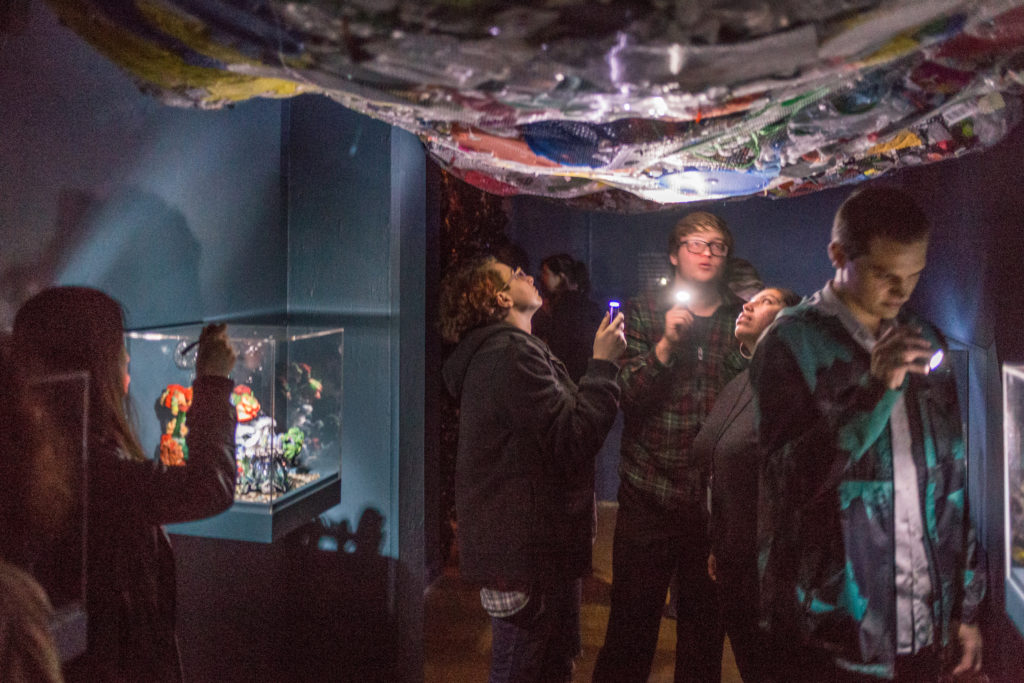
Visitors exploring miniature coral “Pod Worlds” arranged beneath “The Midden” – four years worth of Margaret and Christine Wertheim’s domestic plastic trash suspended from the ceiling in a fishing net.
UCSC_CoralReef_2017_118**

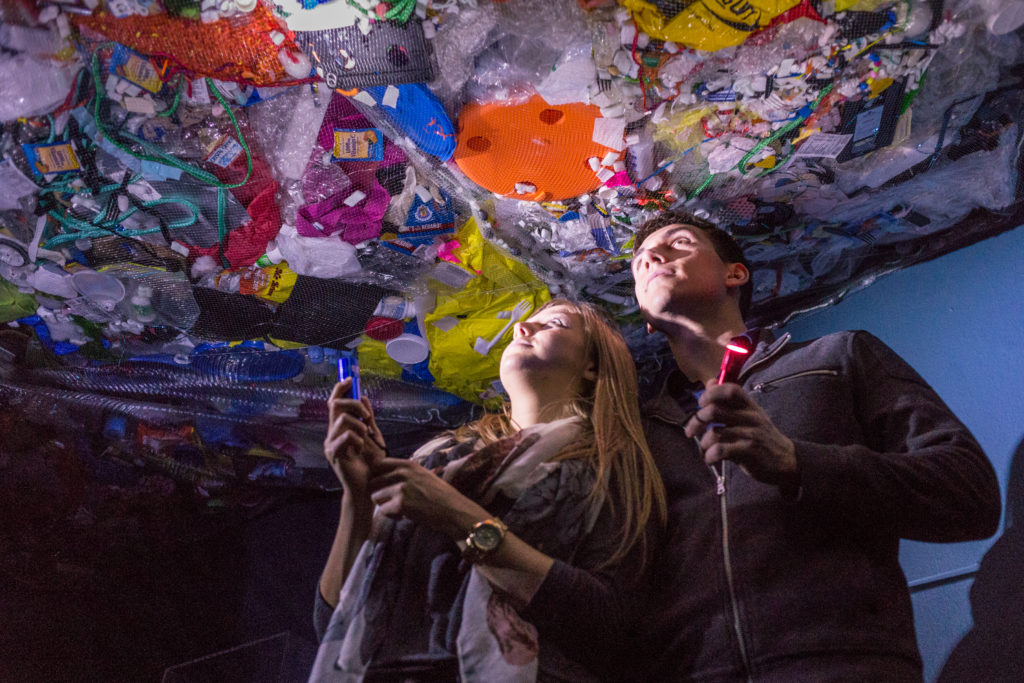
Spelunking beneath “The Midden” – four years worth of Margaret and Christine Wertheim’s domestic plastic trash.

The IFF’s work on this exhibition has been generously supported by a grant from the Opaline Fund of the Jewish Community Federation and Endowment Fund.

Special thanks to Anna Mayer, John Weber, Shelby Graham, Rachel Nelson, Donna Haraway.

Maintenance Art, Climate Change, Women-in-Science

Jan 22 Sun
@ Museum of Arts and Design

Final Week


On January 22, 2017, the IFF’s exhibition Crochet Coral Reef: TOXIC SEAS ends its season at the Museum of Arts and Design, NY. Here IFF director Margaret Wertheim offers some reflections on the show’s intersection with trends in art and science over the past year.

PHOTOGRAPHY BY JENNA BASCOM

2016 witnessed a renewed interest in feminist art practice in the USA and Europe. In NY, the Queens Museum hosted the first major retrospective of Miele Laderman Ukele’s “maintenance art,” a term she initially coined to encompass the domestic work women do, and later expanded to include work by janitors, museum care-takers and sanitation workers. Aeon magazine also published an essay on maintenance and its resonances for the sciences, where, the authors note, the bulk of effort also goes into maintaining and stabilizing theories and practices rather than much vaunted “innovation.” Feminists have long championed maintenance, and at the IFF our Crochet Coral Reef project is also about visibilizing unseen care work, since caring for the environment is necessarily an extension of caring for one another, a set of responsibilities that still falls largely to women.

In London at the ICA a series of films was curated by Radclyffe Hall, a collective of writers and artists who explore “culture, aesthetics and learning through the lens of contemporary feminism.” And in Los Angeles an initiative launched by Metabolic Studio aims to “animate the archives” of the Women’s Building, a pioneering site of feminist art started in 1973 by Judy Chicago, Sheila de Bretteville and Arlene Raven. Meanwhile Schimmel Hauser and Wirth in LA opened with fanfare devoting its entire 100,000 square feet of space to the inaugural show Revolution in the Making: Abstract Sculpture by Women 1947 – 2016. This vast diverse conclave featured assemblages by Lee Bonticu and Louise Bourgeois, groves of wire pod-forms by Ruth Asawa, geometric nets by Gego, topologically knotted ropes by Francois Grossen, and much more.

2016 has also been an important year for women in science, beginning on a sober note with much needed commentary about the ongoing issue of sexual harassment by senior scientists and professors. I wrote about this for Aeon, and the publication of Hope Jahren’s book Lab Girl brought the issue to the fore. 2016 also saw the passing of Vera Rubin, first lady of dark matter, another deserving women scientist who should have been awarded a Nobel Prize. Yet the year ended on a high with the publication of two thrilling books: The Glass Universe by Dava Sobel, telling the story of women “calculators” at the Harvard Observatory whose precise calculations of stars and galaxies from astronomers’ glass plates paved the way for the discovery of the Big Bang; and Margot Lee Shetterly’s Hidden Figuresabout the African American women who did the sums that put white men into space. Now also in cinemas as a hit feature film.

No discussion of 2016 would be complete without a look at climate change. This is the third-in-a-row, hottest-year-on-record. According to NASA studies, between 2013 and 2016 global temperatures have risen by more than 0.5˚F, “a huge change” in such a short time for our planet and an alarming figure for us all. Continued rampant warming makes the Crochet Coral Reef’s constructive, community-based approach to public engagement around climate change all the more salient.

As we head into an uncertain future, at the IFF we affirm our commitment to working at the nexus of art, science, environmentalism and feminism. After MAD, the Crochet Coral Reef will be on exhibit at UC Santa Cruz, home of science studies scholar Donna Haraway, whose powerful new book Staying with the Troubles, also focuses on living constructively on a damaged planet. The exhibition at UCSC’s Mary Porter Sesnon Gallery, runs from Feb 10 – May 6, 2017.


Photo credit: Coral Forest, by Margaret and Christine Wertheim and the Institute For Figuring, at the Museum of Arts and Design, NY, 2016. Photo by Jenna Bascom, courtesy MAD.


Solidarity + Scientific American

“After the revolution, who’s going to pick up the garbage?” There’s one more week to go of the IFF’s exhibition Crochet Coral Reef: TOXIC SEAS at the Museum of Arts and Design, NYC, (on until Jan 22, 2017). Also ending soon is the major retrospective of Mierle Laderman Ukeles “maintenance art” show at the Queens Museum. Reef creators Christine and Margaret Wertheim are honored to have shared the Manhattan stage with this pioneering feminist artist. Pictured below, Coral Forest – Stheno stands in solidarity with maintenance art practitioners and working women everywhere.

And here in Scientific American Margaret muses on new ways of expanding science communication and the Crochet Coral Reef as a powerful tool for using art+craft to move beyond the fear-factor of climate change. With 2016 the third-in-a-row, hottest-year-on-record, the Crochet Reef’s constructive, community-based approach to this topic is more salient than ever.

See here: IFF exhibition webpage and photo-gallery.

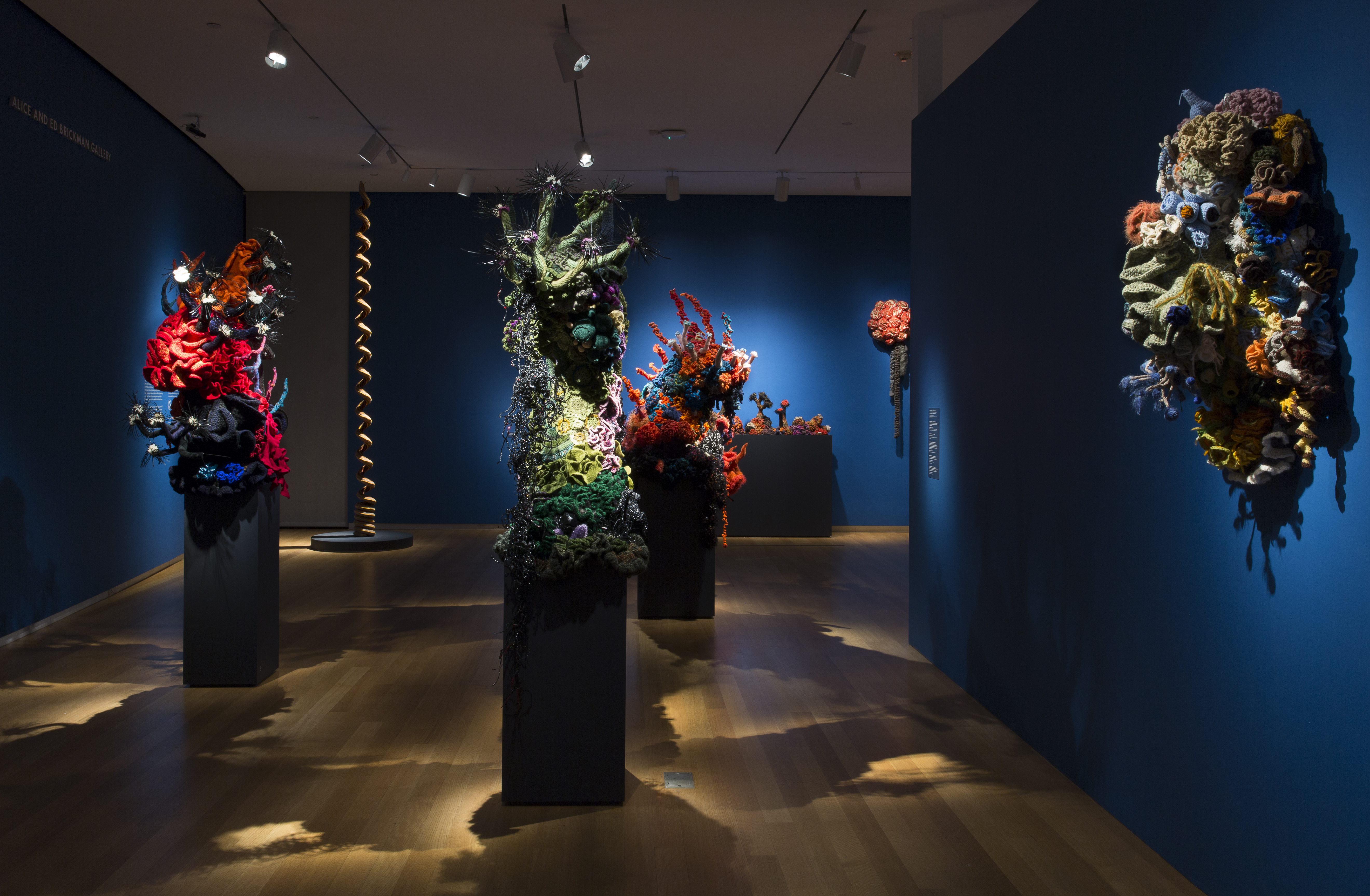
Crochet Coral Forest, at the Museum of Arts and Design, NY, 2016/2017. Photo by Jenna Bascon, courtesy MAD.

Crochet Coral Forest – Stheno by Margaret and Christine Wertheim, at the Museum of Arts and Design, NY. Collection of Jorian Polis Schutz. Photo by Jenna Bascom, courtesy of MAD.


Paris Agreement + MAD

PHOTOGRAPHY BY JENNA BASCOM

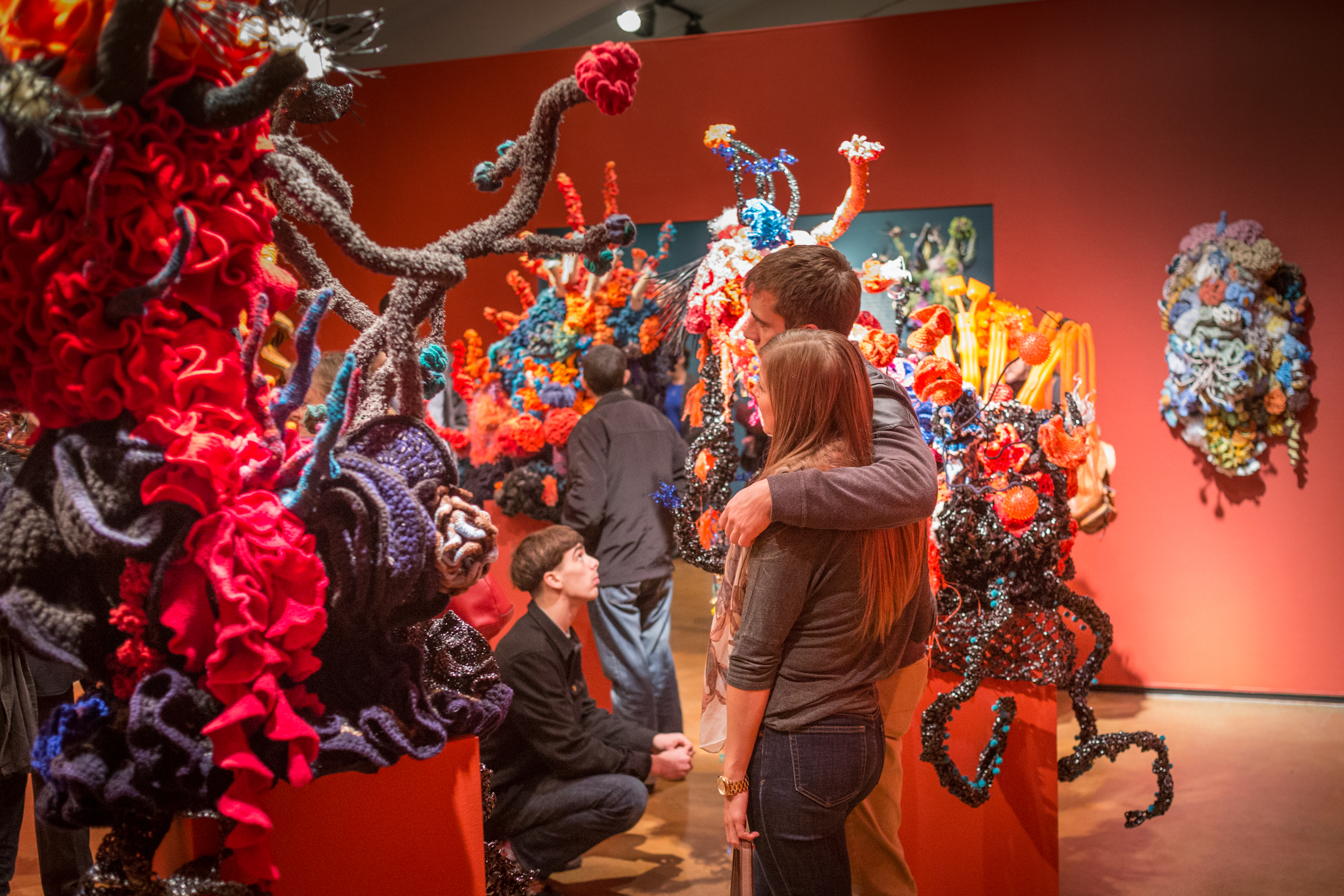
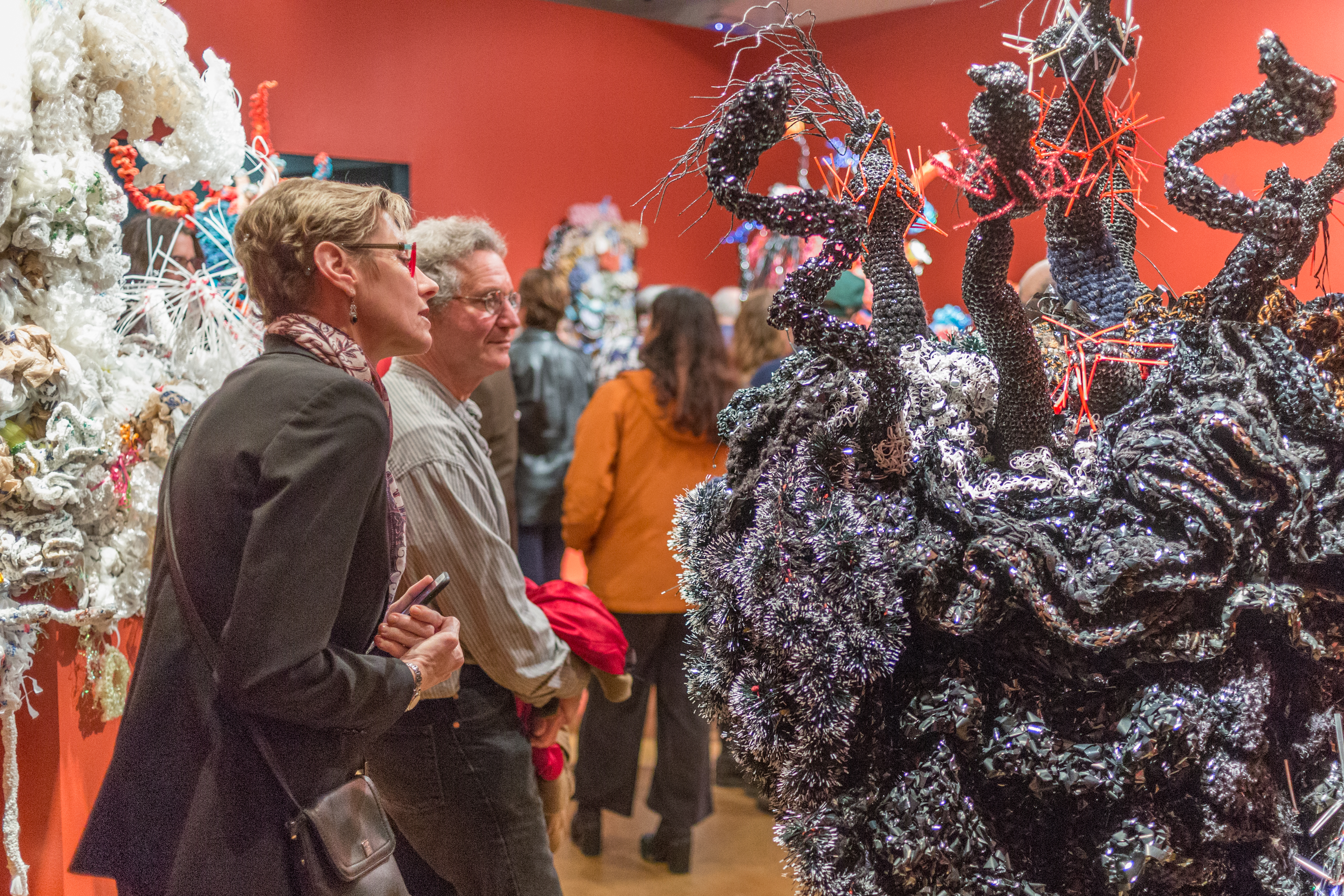
December 12 is the first anniversary of the Paris Agreement on climate change outlining commitments to reducing greenhouse gas emissions. In the spirit of Paris, the IFF’s exhibition Crochet Coral Reef: TOXIC SEAS continues at the Museum of Arts and Design in Manhattan. The show runs through January 22, 2017. Highlights include two bleached crochet reefs; a rare showing of The Midden (Margaret and Christine’s monumental personal-plastic-trash pile suspended in a fishing net as a commentary on our individual participation in oceanic trash); plus a site-specific, 30-foot long blackboard charting the chemistry of life and its entanglements with CO2 and plastic.

Photo credits: (Top) Crochet Coral Reef: TOXIC SEAS, by Margaret and Christine Wertheim and the Institute For Figuring, at Museum of Arts and Design, NY 2016. (Bottom) The Midden, four years worth of the Wertheim's domestic plastic trash. [Photos by Jenna Bascom courtesy of MAD.]

Photo credits: (Top) Crochet Coral Reef: TOXIC SEAS by Margaret and Christine Wertheim and the Institute For Figuring, at the Museum of Arts and Design, NY 2016. (Bottom) The Midden, four years worth of the Wertheim’s own domestic plastic trash suspended in a fishing net; in the background is the Chemical Blackboard with a timeline of organic chemistry and the rise of CO2. [Photos by Jenna Bascom courtesy of MAD.]