Fractal Ruin for MASS MoCA

Apr 25 Mon
@ Institute For Figuring

Sculpture Send-off


P1200760

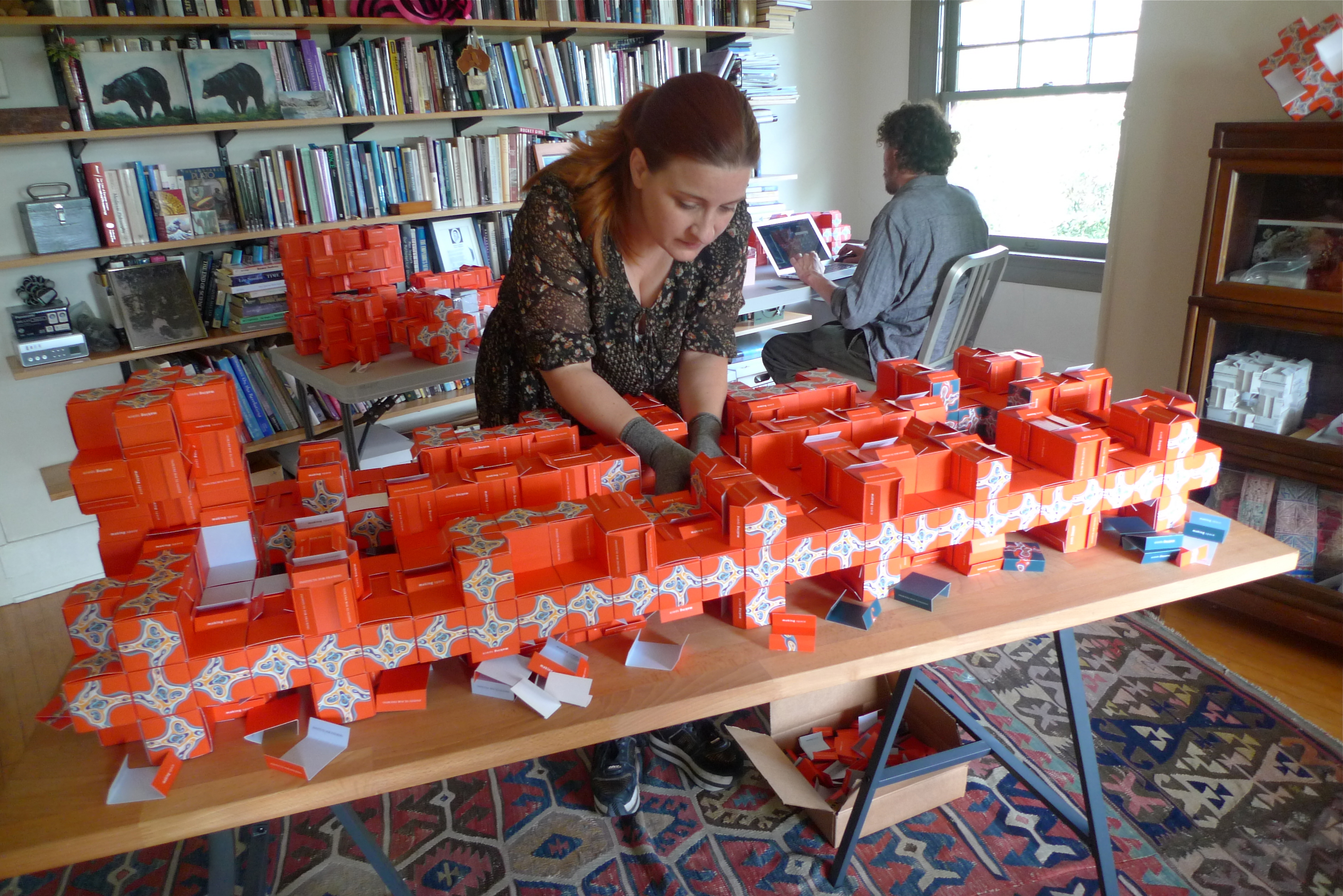
Christina Simons and Jake Dotson assembling “Fractal Ruin” at the Institute For Figuring, Los Angeles, April 2016.

What can you do with business cards? You can hand them out to colleagues, or you can fold them into cubes.

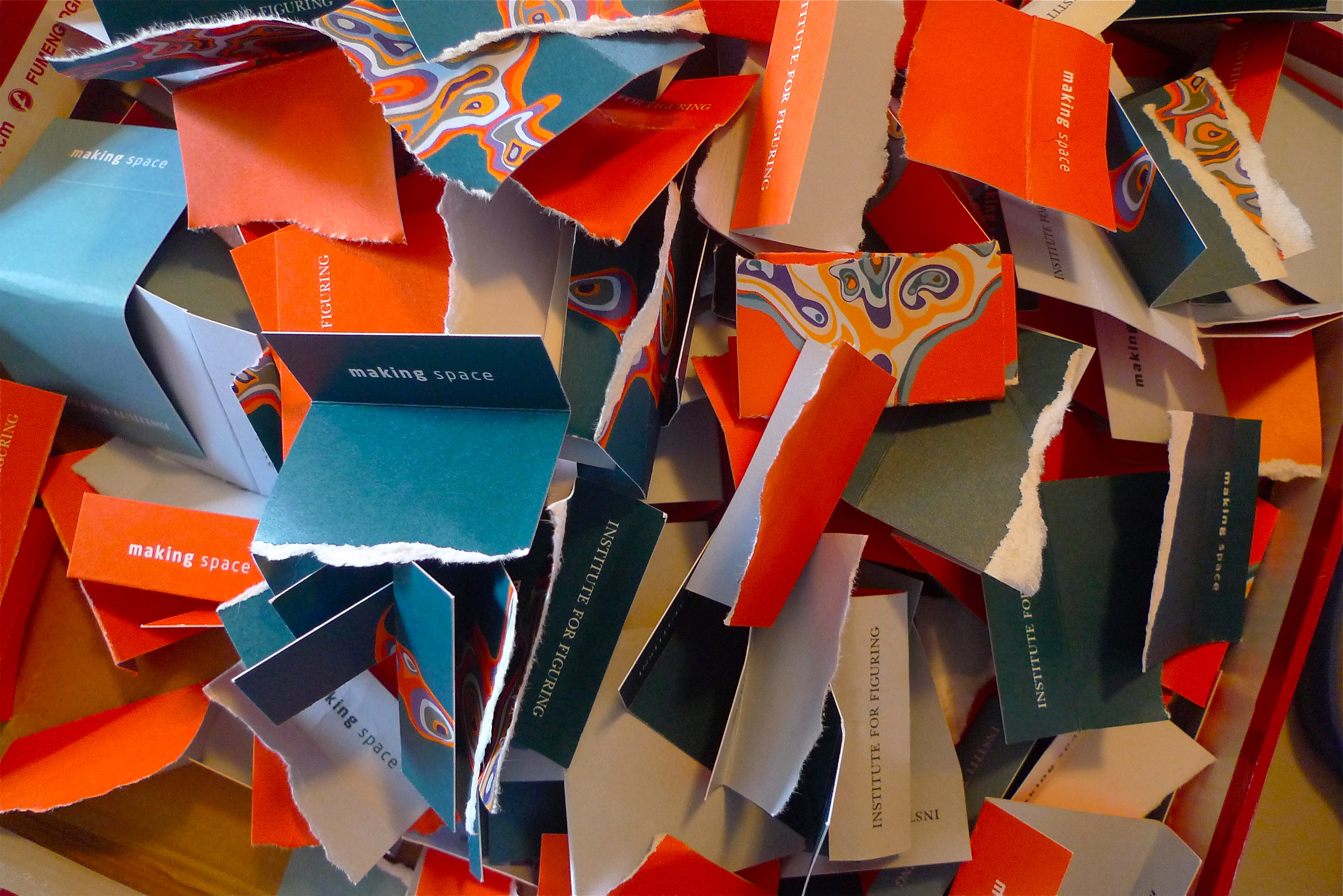
What can you do with 10,000 business cards? This month the IFF set out to explore that question with 10,000 specially designed fluorescent orange cards embellished with psychedelic swirly patterns. Our inspiration is the pioneering work of Dr. Jeannine Mosely, inventor of business card origami and world-leading practitioner of fractal paper folding.
P1200874

Business cards designed for the IFF by Cindy Kusuda and Margaret Wertheim.

In the late 1990’s, Mosely famously folded a level three Menger Sponge fractal out of 66,000 business cards, an object that the IFF exhibited at Machine Project in 2006. The Mosely-IFF collaboration continued in 2012 when together we undertook the construction of the more challenging Mosely Snowflake Sponge fractal out of 50,000 cards at USC. That endeavor piqued our interest: what else, besides fractals, could be created using these techniques?
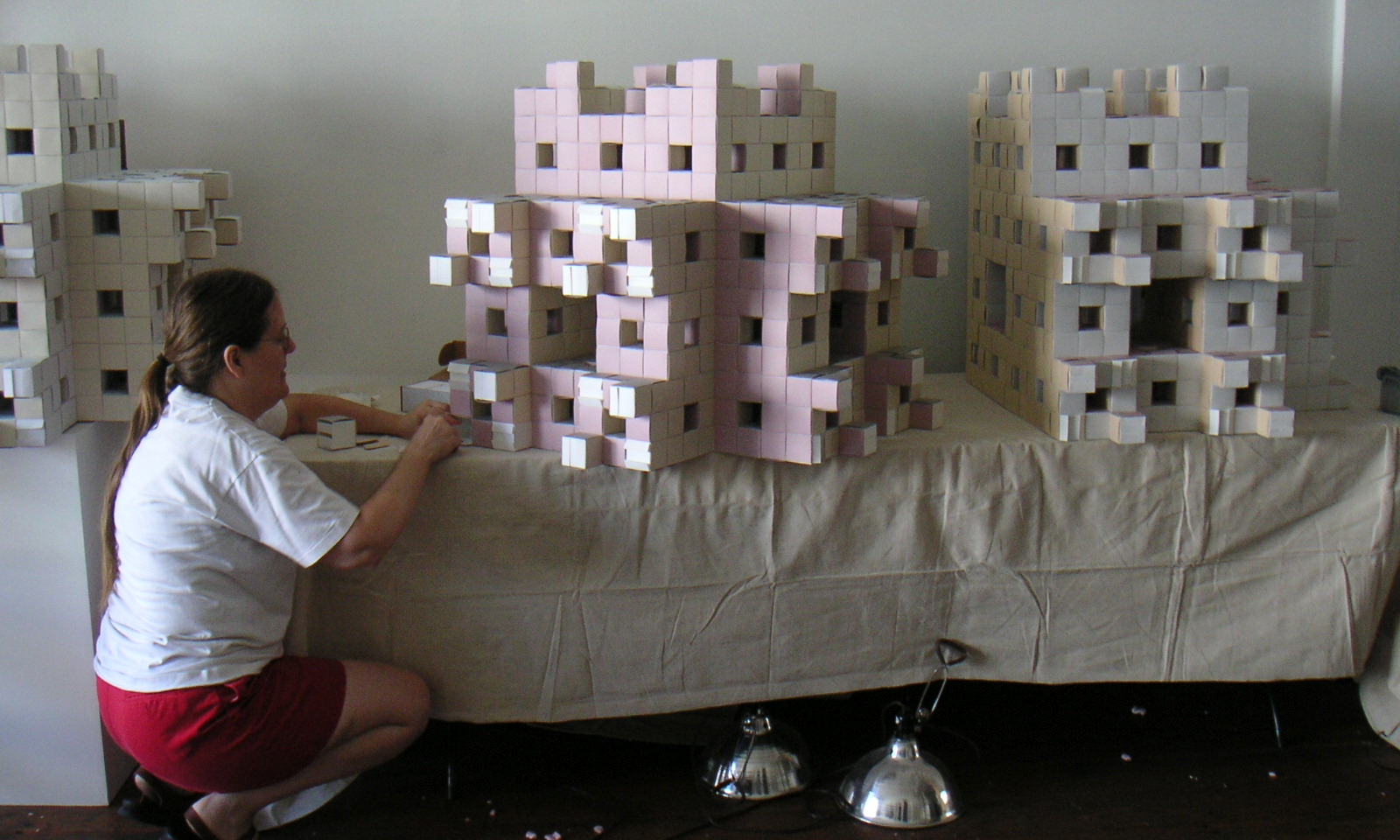
Dr. Jeannine Mosely assembling octants of the “Business Card Menger Sponge” at Machine Project, Los Angeles, 2006. Exhibition curated by the IFF.

Fractals – perfectly regular geometric structures – are self-similar at every scale, thus each level of a fractal has the same architecture. The natural world abounds in fractal forms: clouds, coastlines, forked lightening, ferns and broccoli are all in this class. Yet nothing is nature is perfectly mathematical. What would happen, we wondered, if we followed this organic lead, allowing ourselves to deviate from the geometric ideal?
P1200866

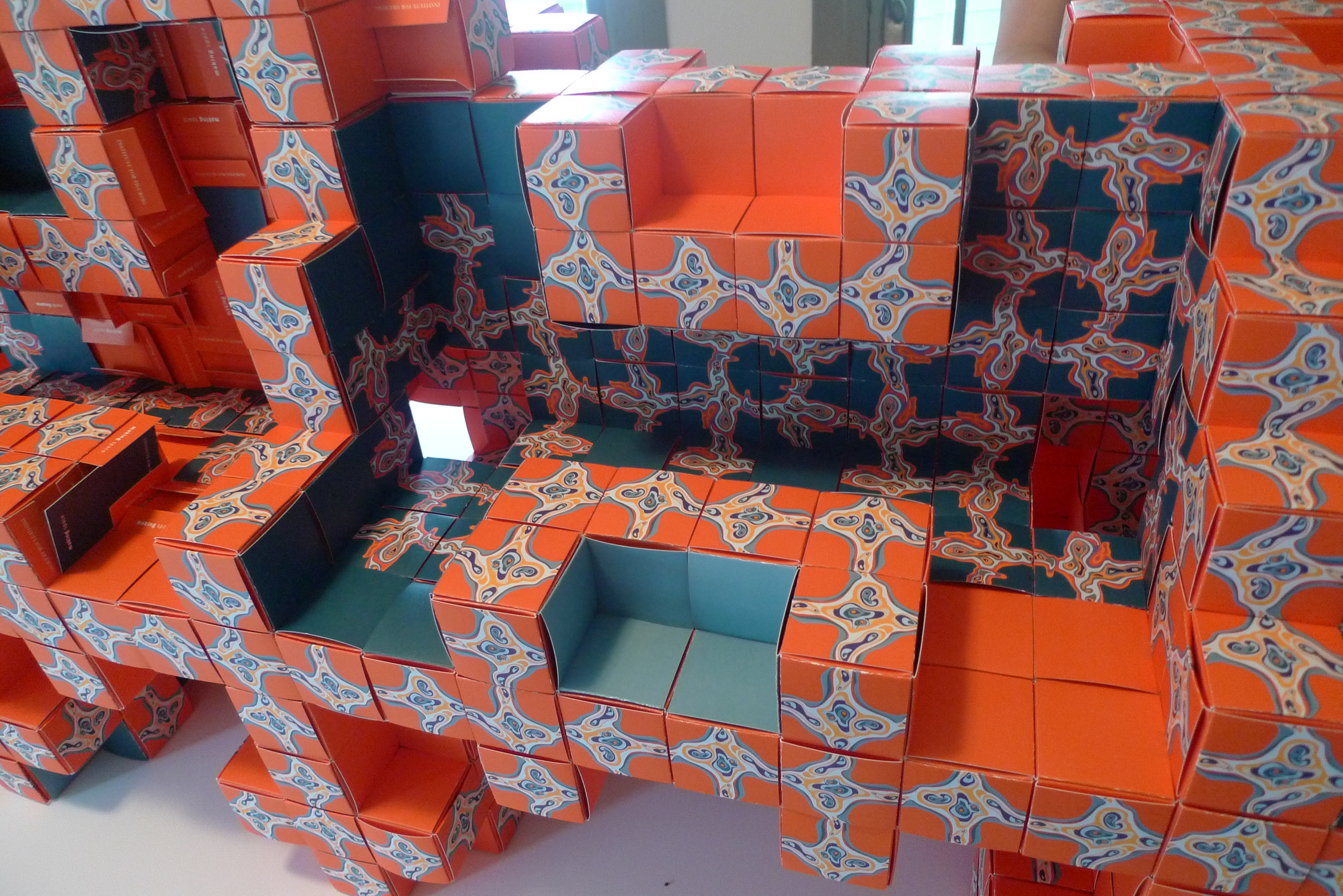
Detail of “Fractal Ruin” by the Institute For Figuring, revealing degenerate fractal structure.

For the past month we’ve been conducting an experiment, giving ourselves license to go wild. From the simple seeds of Mosely’s cubes we’ve been exploring the genetic potential of fractal architecture loosed into the realm of organicism. Just as living creatures evolve over time, so too our fractal monster has been evolving as it grows; changing, morphing and gradually acquiring a unique deviant glory.
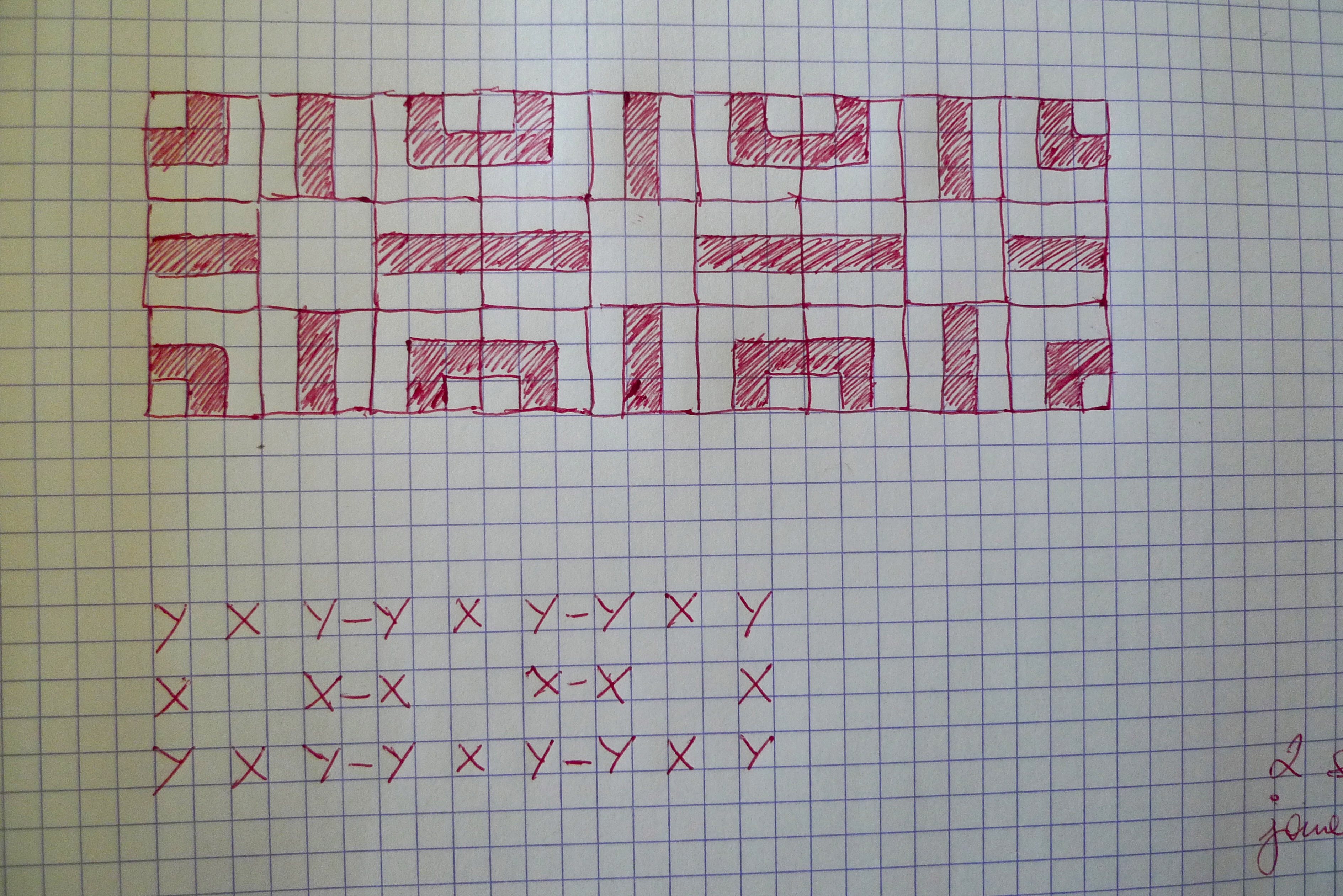
P1200704

Arrangement of X and Y modules in the mid-section layer of a “Mosely Snowflake Sponge Business Card Origami Fractal Tower” (drawing by Margaret Wertheim).

The resulting object, a Fractal Ruin, will be exhibited at MASS MoCA in the forthcoming exhibition Explode Every Day: An Inquiry into the Phenomemon of Wonder, opening May 28, 2016.

Also in the exhibition will be a business card origami wall frieze that we’ll grow on-site on the gallery walls.
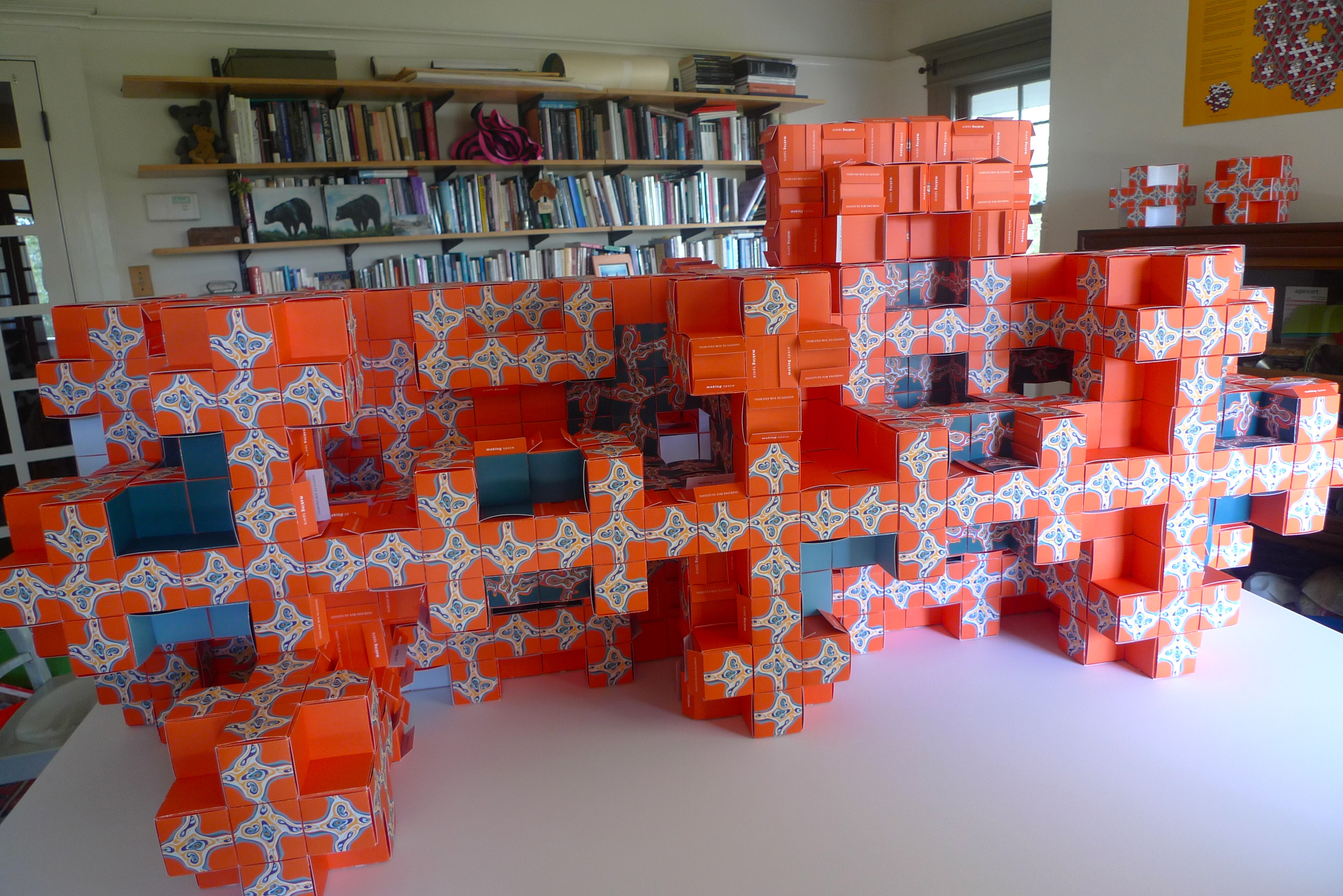
P1200856

“Fractal Ruin” sculpture in process at the Institute For Figuring, April 2016.

Fractal Ruin by Margaret Wertheim and the Institute For Figuring has been constructed with design assistance from Christine Wertheim. Folded by Christina Simons, Jake Dotson and Margaret Wertheim.

Explode Every Day: An Inquiry into the Phenomenon of Wonder is co-organized for MASS MoCA by curator Denise Markonish and artist Sean Foley.

Artists in the exhibition include: Pierre Huyghe, Fred Tomaselli, Michael Light, Nina Katchadourian, Tom Friedman, Tristan Duke, Ryan and Trevor Oakes, and the Institute For Figuring.
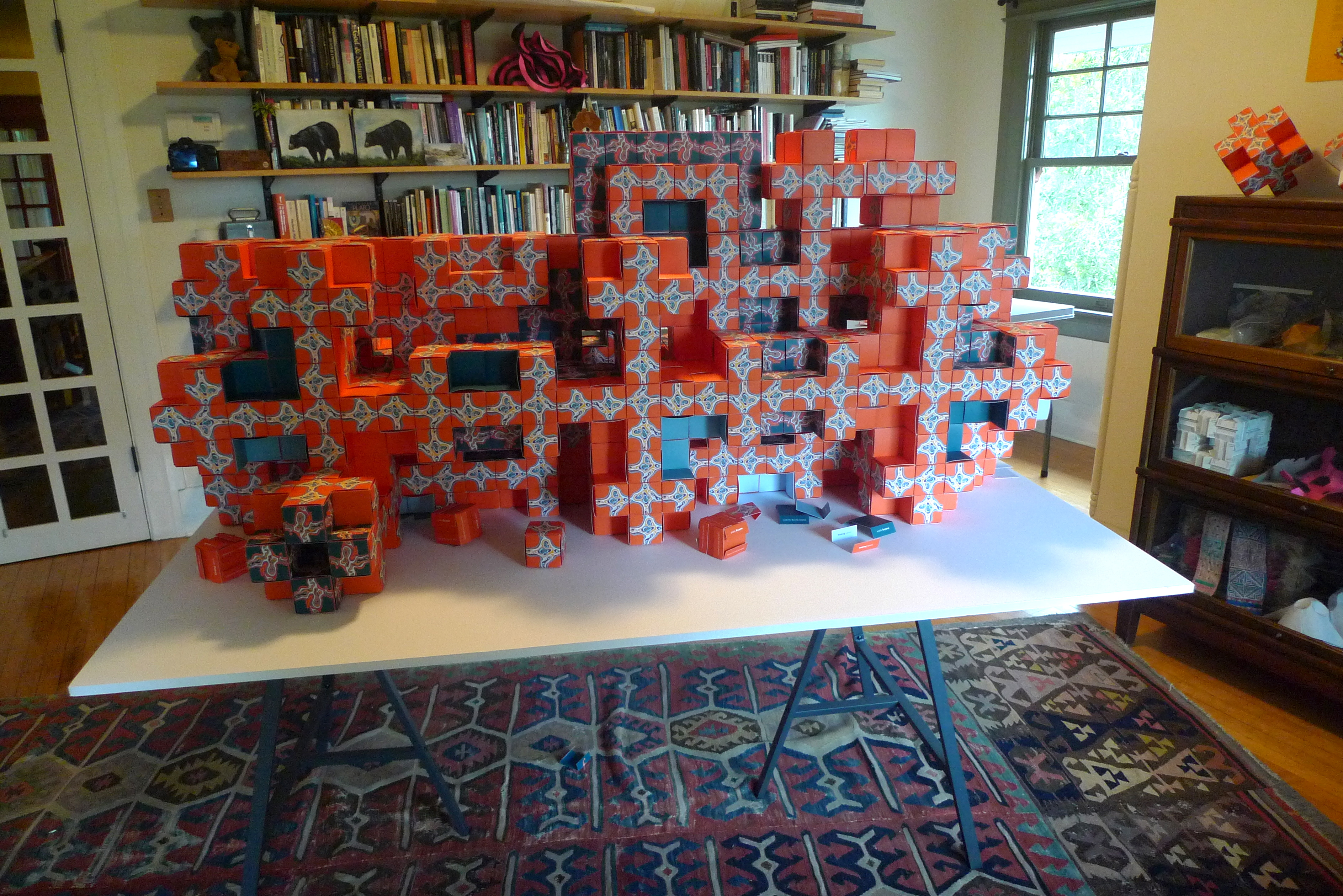
P1200953

Nearly complete “Fractal Ruin” at the Institute For Figuring, Los Angeles, April 2016.

Coral Bleaching

2015_06_MIA025 (photo credit-Margaret Wertheim, IFF) copy

The “Bleached Reef” by the Institute For Figuring. Photographed at the exhibition “Night Begins the Day” at the Contemporary Jewish Museum, San Francisco, 2015.

The world’s coral reefs are experiencing the largest bleaching episode ever recorded. Rising water temperatures are now threatening more than a third of the Earth’s reefs and coral experts say it is possible reefs may be gone in 25 years. The effects of the current El Nino (making the last 2 years the hottest on record), are being compounded by underlying global warming and other anomalous climate events. Hardest hit has been the Great Barrier Reef. During a recent aerial survey of 520 sub-reefs in its northern section, scientists at Australia’s National Coral Bleaching Task Force found that only 4 showed no sign of bleaching. More than 600 miles of the GBR’s previous glory has been turned into aquatic boneyards. [See photo essay.] “This has been the saddest research trip of my life,” says Task Force convener Professor Terry Hughes.

In this time of urgency, the IFF’s Crochet Coral Reef project remains ever-more timely; a synthesis of art and science that also calls attention to the potency of community-based action. In Fall 2016 the Crochet Coral Reef will be on exhibition at the Museum of Arts and Design in NY. Included will be our Bleached Reef, a feminine handicraft elegy to the currently unfolding environmental tragedy.

Crocheted strawberry anemones (by Margaret Wertheim) nestling in the Bleached Reef, by the Institute For Figurirng. Pictured at the Jewish Contemporary Museum, San Francisco, 2015.

Crocheted strawberry anemones (by Margaret Wertheim) nestling in the “Bleached Reef” by the Institute For Figuring. Photographed at the exhibition “Night Begins the Day: An Exploration of Space, Time and Wonder” at the Contemporary Jewish Museum, San Francisco, 2015.

________________________________________________________

The IFF is making a fractal

P1200760

Christina Simons and Jake Dotson constructing “Fractal Ruin” at the Institute For Figuring, Los Angeles, April 2016.

The IFF has begun construction on a new business card origami fractal sculpture for a forthcoming exhibition at Mass-MoCA entitled Explode Every Day: An Inquiry into the Phenomenon of Wonder. We are inspired here by the pioneering work of Dr. Jeannine Mosely, inventor of business card origami and the leading practitioner of fractal paper folding. By experimenting with Dr. Mosely’s techniques we are bringing into being an object that shimmers at the boundary of mathematics and nature, a structure whose spine is based on fractional geometric principles and whose flesh is being “grown” organically as we progress. The IFF’s previous collaboration with Dr. Mosely was the construction of giant Mosely Snowflake Sponge Fractal at the USC Libraries.

___________________________________________________________

Things to do with Spheres

E8 lattice (from Wikipedia)

E8 lattice (from Wikipedia)

It’s turning into an exciting week for spheres. In a tour de force of abstract thinking, mathematicians have finally proved how to best pack spheres in 24-dimensional space. We all know this problem in 3 dimensions: What’s the best way to stack oranges? In 1611, Johannes Kepler speculated that the pyramidal stacking used by grocers was the optimal arrangement, but it took until 1998 for that to be proved. Since then mathematicians have wondered about optimal sphere-packing in higher dimensions. They know the answer for 2 and 3 dimensions, but this is a hard problem to generalize. Some years ago it was speculated that in 8 dimensions the answer could be found in the structure of a glorious object known as the E8 lattice. Now Maryna Viazovska at Humboldt University in Berlin has proved this is optimal. By extending her work, Viazovska and a colleague were also able to deduce the answer for 24 dimensions, which involves one of E8’s cousins. Nobody knows why 8 and 24 dimensions are so elegant and special. 24 dimensional sphere-packing has applications in wireless communications, particularly involving spacecraft where signals are faint and noisy, so there is a link here to the cosmos itself. The IFF is delighted by these developments: in 2009, IFF director Margaret Wertheim wrote about E8 and its cousin “the monster symmetry group” in this article for Cabinet magazine.

In other rotund news, we draw readers attention to this video demonstration of hikaru dorodango, the ancient Japanese craft of making perfect spheres out of dirt. Here, artist Bruce Gardner shows how. Mud meets math, a meticulous fusion of the mundane and the sublime.

__________________________________________________________

Connecting the Dots

Mar 03 Thu
7:30pm @ Hammer Museum, Los Angeles

Public Discussion


Diagram of the types of English vocabulary included in the OED, devised by James Murray, its first editor.

Connecting the Dots: Making Meaning of the World 

@Hammer Museum, 

How do knowledge systems such as the Oxford English Dictionary conform to or change the way our brains function? Why are humans driven to categorize the world? National Book Award finalist James Gleick (The Information: a History, a Theory, a Flood) and Lera Boroditsky, UCSD professor of cognitive science—who researches the relationships between mind, body, world, and language—discuss the history and future potential of these ideas. Moderated by Margaret Wertheim, science writer (The Pearly Gates of CyberspacePhysics on the Fringe) and codirector of the Institute For Figuring.

This program is in conjunction with Hollywood is a Verb, a citywide, monthlong initiative of the Library Foundation of Los Angeles and the Los Angeles Public Library, looking at the Oxford English Dictionary through a contemporary Southern California lens.

Event date/time: Thursday March 3, 2016, 7:30pm

Hammer event website

Image credit: Diagram of the types of English vocabulary included in the first edition of the OED, devised by its editor James Murray. Courtesy Wikipedia.

Creative Imperatives Festival

Mar 01 Tue
9:00am - 12noon @ University of WI, La Crosse

Workshop


Sunday March 28 through Tuesday March 1, the School of Arts and Communication at the University of Wisconsin, La Crosse, is hosting its third annual Creative Imperatives festival, a 3-day-long slate of presentations, performances, lectures, workshops and activities. This year’s theme is Wonder and Curiosity: The Intersection of Art and Science.

Tuesday, March 1st, 9am-12noon, IFF Director Margret Wertheim will host a hands-on workshop to teach techniques for crocheting corals. Experienced crocheters and beginners are equally welcome. Hooks and yarns will be supplied.

Plastic bag crochet.

The workshop will help to launch the University of Wisconsin, La Crosse School Reef, a campus-wide endeavor in which students, faculty and staff will construct their own crochet reef. This year-long participatory project will culminate in an exhibition of the UW-La Cross School Reef in 2017.

Workshop title: Crocheting Corals 

Place: Room 203, Center for the Arts, University of Wisconsin La Crosse

Time: 9am-12noon

Festival Program PDF

Creative Imperatives Festival

Feb 29 Mon
7:30pm @ University of WI, La Crosse

Public Lecture


Sunday March 28 through Tuesday March 1, the School of Arts and Communication at University of Wisconsin, La Crosse, is hosting its third annual Creative Imperatives festival, a 3-day-long slate of presentations, performances, lectures, workshops and activities. This year’s theme is Curiosity and Wonder: The Intersection of Art and Science.

On Monday February 29 @ 7:30pm, IFF Director Margret Wertheim will give a public lecture for the festival reflecting on 10 years of the Crochet Coral Reef project and its unique nexus of art, science, handicraft, mathematics, environmentalism and feminism.

UWI-La Crosse, Creative Imperatives

UWI-La Crosse, Creative Imperatives

Lecture title: Crochet Coral Reef: A Yarn About Art, Science and Climate Change 

Place: Annett Recital Hall, Center for the Arts, Univrsity of Wisconsin La Crosse

Time: 7:30-9pm

In this presentation, Reef co-creator Margaret Wertheim will discuss the Crochet Coral Reef”s roots in mathematics, art and craft, and the project’s ever-more relevant message about climate change. In early 2016, living reefs around the world are experiencing one of the  most massive bleaching events on record, due to the extreme El Nino conditions occurring now in the Pacific Ocean. Questions are being raised by scientists as to whether coral reefs will survive past the 21st century. The Crochet Reef project calls attention to this ecological crisis through a worldwide collaborative process of active, ongoing, community-centered making. Wertheim’s talk will draw forth the positive potential of such collective action, and discuss how the Crochet Coral Reef can serve as a metaphor for hope as we continue to confront an increasingly challenging eco-future.

Wertheim’s talk also coincides with the launch of the University of WI La Crosse School Reef, the latest addition to the IFF’s  ever-evolving archipelago of Crochet Coral Reefs worldwide.

Download Festival PDF.

Steward School, VA

Feb 16 Tue
6:00 - 7:30pm

Public Lecture


On Tuesday Feb 16, IFF director Margaret Wertheim will give a talk about the Crochet Coral Reef project at The Steward School in Richmond, VA. The talk will celebrate the 10th anniversary of the Reef project and reflect on a decade of work at the intersection of art, science, mathematics, handicraft, environmentalism and feminism.

The event is held in the school’s Bryan Innovation Lab, “a 21st-century, problem-solving environment. Through experiential learning in this cutting-edge facility, students are able to grapple with real world issues, challenging their critical thinking and resourcefulness.”

The Steward School Satellite Reef, which is currently under construction, is the latest addition to the IFF’s worldwide Crochet Coral Reef project.

Crochet Coral Reef turns 10

The IFF’s Crochet Coral Reef project is celebrating its 10th anniversary with the announcement of two new forthcoming exhibitions: one in Spring 2017 at the University of California, Santa Cruz; the other at a soon-to-be announced location for Fall 2016.

Over the past decade the Crochet Coral Reef project has evolved into one of the largest participatory art and science endeavors on the planet and – we are proud to say – one of the very few that specifically brings science and mathematics to women.

With its unique nexus of mathematics, handicraft, community art practice and environmentalism the Crochet Coral Reef project opens a window into STEM subjects for women around the world.

AbuDhabi-wide copy

During the past 10 years, more than two million people have visited Crochet Coral Reef exhibitions, including at the Hayward Gallery in London, Science Gallery in Dublin, Andy Warhol Museum in Pittsburgh, and the Smithsonian’s National Museum of Natural History in Washington DC. In 2015, the Reef was exhibited at the Minneapolis Institute of Arts, alongside the Leonardo da Vinci Leicester Codex.

More than 8000 women in a dozen countries on 5 continents have participated with us in making an ever-evolving wooly archipelago of community-based Satellite Reefs. This ongoing socio-artistic happening simultaneously engages women with the foundations of geometry and the problems of climate change while calling forth their creative energies. Satellite Reefs have now been constructed in 35 cities and countries around the globe, including Chicago, New York, London, Melbourne, Germany, Latvia, Ireland and the United Arab Emirates (seen here at the NYU Abu Dhabi Institute).

___________________________________________________________________________________

Women and Mathematics

Jan 11 Mon
11am - 12noon @ RMIT, Melbourne Australia

Morning Tea - AMSI


As part of the Australian Mathematical Sciences Institute’s annual Summer School, IFF director Margaret Wertheim will be talking about the subject of women and mathematics and how we can improve STEM communication to women and girls.

Date: Monday Jan 11, 2016, 11am-12noon

Location: RMIT, Melbourne Australia (Building TBA)

Margaret Wertheim has undergraduate degrees in mathematics and physics. Originally intending to become a research physicist, she ultimately decided to become a science communicator, and has spent the past 30 years pioneering new ways of creatively engaging audiences with mathematics and science. Margaret is the author of six books, including the internationally acclaimed Pythagoras’ Trousers, which traces the cultural history of the quest to understand physical reality in mathematical terms.

A specific feature of Margaret’s work has been finding ways to engage women and girls with STEM subjects. For ten years in her native Australia she wrote regular columns about science for women’s magazines, including Australian Vogue and Elle Australia. She may be the only journalist in the world to have held such a position. For ABC Australia, she also conceived, wrote and co-directed a ground-breaking 6-part television science series, called Catalyst, that was aimed at teenage girls.

In 1991 Margaret moved to Los Angeles where she founded the Institute For Figuring, a non-profit organization devoted to “the aesthetic and poetic dimensions of science and mathematics.” Through the IFF she has curated art+science exhibitions for museums and galleries around the world, including the Hayward Gallery in London and the Smithsonian Institution in Washington DC. The IFF’s Crochet Coral Reef project – which she created with her artist-twin-sister Christine – is the largest participatory art and science project on the planet and has had more than 8000 active contributors in a dozen counties on five continents. Through an unlikely combination of geometry and handicraft, the Crochet Coral Reef educates women about the foundations of mathematics while also drawing attention to the devastating impact of climate change on living coral reefs. The Crochet Coral Reef project has been called “the AIDS quilt of global warming.”